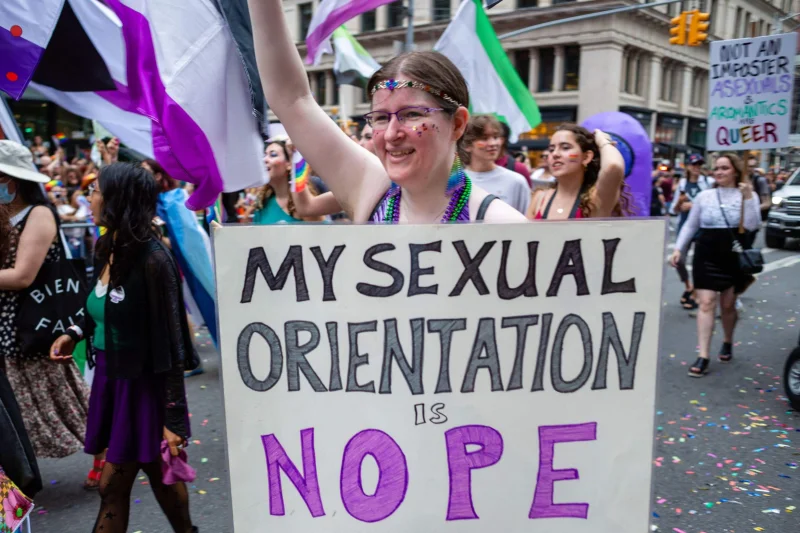
The findings, published in a brief based on the Annual LGBTQ+ Community Survey (ALCS), paint a stark picture. While many within the queer community have noted a chilling effect from rising anti-LGBTQ+ rhetoric, the impact appears to be disproportionately affecting those on the asexual spectrum.
The Data at a Glance
The survey reveals a clear disparity between the experiences of asexual respondents and the LGBTQ+ community as a whole over the past year:
- Perceived Acceptance: 50.9% of asexual respondents reported a decline in acceptance, compared to 29.7% of all LGBTQ+ adults.
- Being Out: A majority of asexuals (57.3%) said they were less out than a year ago, versus 47.5% of the overall community.
- Public Visibility: Nearly two-thirds (63.7%) of ace respondents felt less visible—for example, by wearing Pride symbols—compared to 51.1% of all LGBTQ+ adults.
These figures suggest that a community just beginning to gain mainstream recognition is now being pushed back into the shadows. Asexual activist Yasmin Benoit, who consulted on the report, noted the precarious position of the community. "Asexual people who were gradually approaching the point of feeling safe enough to be open are retreating backward again or deeming it necessary to stay in the background," she stated.
A Diverse Community with Varied Experiences
The report, which surveyed nearly 10,000 LGBTQ+ adults in the US, found that 4.7% identified as asexual. However, the term 'asexual' is a broad umbrella. Only 16.9% of these respondents identified *solely* as asexual. The vast majority (83.1%) held multiple identities, such as 'asexual lesbian' or 'panromantic asexual'.
This diversity is reflected in the data. Interestingly, those who identified only as asexual were far more likely to report worsening acceptance (71.7%). In contrast, those with additional identities (e.g., 'ace and bi') were more likely to report being less out (60.9%) and less visible (66.7%).
Benoit suggests this could be because having another queer identity may connect a person to more established support networks, like lesbian or bi communities, which can buffer against declining acceptance. At the same time, holding multiple marginalized identities can compound the reasons one might choose to be less visible in a hostile environment.
The Critical Intersection of Ace and Trans Identities
A crucial factor driving these trends is the significant overlap between the asexual and transgender communities. A remarkable 58% of asexual respondents in the survey also identified as transgender or gender-expansive.
When the data is broken down by gender identity, the picture becomes even clearer. Among asexuals, 71.4% of trans and gender-expansive people said they were less visible than a year ago, compared to 45.9% of their cisgender ace peers. This indicates that the intense and targeted rise in transphobia is a primary driver of this retreat from public life for a large portion of the ace community.
Relevance for the Netherlands
While this data originates from the United States, the trends it identifies resonate across the Western world. The rise of anti-trans rhetoric and a general cooling of public support for LGBTQ+ rights are not confined by borders. In the Netherlands, organizations like the Nederlandse Organisatie voor Aseksualiteit (NOA) work to increase understanding and visibility. This report serves as a timely reminder that progress is not guaranteed and that the most marginalized within our community often bear the brunt of social backlash.
As one anonymous respondent shared in the survey, "I recently found out I am asexual... It has been difficult to find community locally." This sentiment underscores the ongoing need for recognition, support, and safe spaces—both online and off—for all members of the queer spectrum.