He Said the Words Out Loud When No One Else Would
In the politically charged atmosphere of 1984 America, with the AIDS crisis raging and moral panic in full swing, a major political figure standing before a national audience and saying the words "lesbian" and "gay" was not just unusual; it was an act of political defiance. Yet that’s precisely what the Reverend Jesse Jackson did at the Democratic National Convention. While other politicians spoke in codes or offered silence, Jackson looked at the nation and described an America that was not a uniform blanket, but a quilt.
"The young, the old, the lesbian, the gay, and the disabled make up the American quilt."
With the passing of the civil rights leader at age 84, it's easy to lose this context. Today, allyship can feel performative, a box to be ticked. But Jackson’s advocacy was forged in an era when supporting queer rights offered zero political gain and significant risk. His was not a late-career conversion; it was a foundational, and often lonely, part of his public life.
More Than a Metaphor: Action and Intersectionality
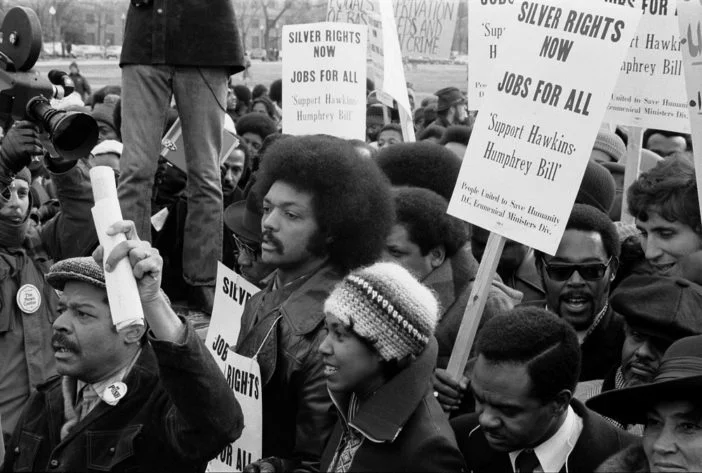
Jackson’s famous "Rainbow Coalition" was not just a catchy slogan. It was a political strategy built on the then-radical idea that the struggles of Black people, Hispanic people, women, workers, and yes, queer people, were interconnected. He explicitly stated, “The rainbow includes lesbians and gays. No American citizen ought to be denied equal protection from the law.”
This was not just talk. His presidential campaigns in the 1980s were the first to seriously court the queer community. He didn't just show up for a photo-op; he:
- Hired openly gay and lesbian staffers.
- Advocated for federal funding for AIDS research at a time when the Reagan administration was criminally negligent.
- Called for an end to the ban on gay people serving in the military.
- Walked at the very front of the 1987 March on Washington for Lesbian and Gay Rights, shoulder-to-shoulder with activists.
He also showed up in the quiet, devastating spaces of the AIDS crisis, visiting hospices and staying overnight, offering comfort when many offered condemnation. This was allyship defined by presence, not press releases.
From Equal Rights to Marriage Equality
Jackson’s support never wavered as the community's political goals evolved. He was there in 1993, telling another March on Washington, “No more homophobia. Let’s respect people, protect people.”
His stance on marriage equality was particularly insightful. In 2004, as Massachusetts became the first state to legalize same-sex marriage, he articulated a principle that still challenges many today: the separation of personal belief from public law.
"In my culture, marriage is a man-woman relationship, but under the law people have a right to choose their own partner."
He wasn't pretending to abandon his own tradition, but he understood that in a pluralistic society, the law must protect everyone equally. He brought that same energy to the fight against California's Proposition 8 in 2010, calling it a product of "ignorance" and "bigotry."
A Lesson in Solidarity
Jesse Jackson’s legacy is a powerful counter-narrative to the idea that allyship is a modern invention. He demonstrated for decades that true solidarity isn't about finding the safest position but about standing with the marginalized, even when it costs you. He used the platform he built fighting racial injustice to demand justice for others, understanding that liberation is a shared project.
In an era of fractured politics, his vision of a multi-faceted, sometimes messy, but ultimately unified "quilt" is not a quaint historical footnote. It’s a roadmap that remains as relevant as ever.