
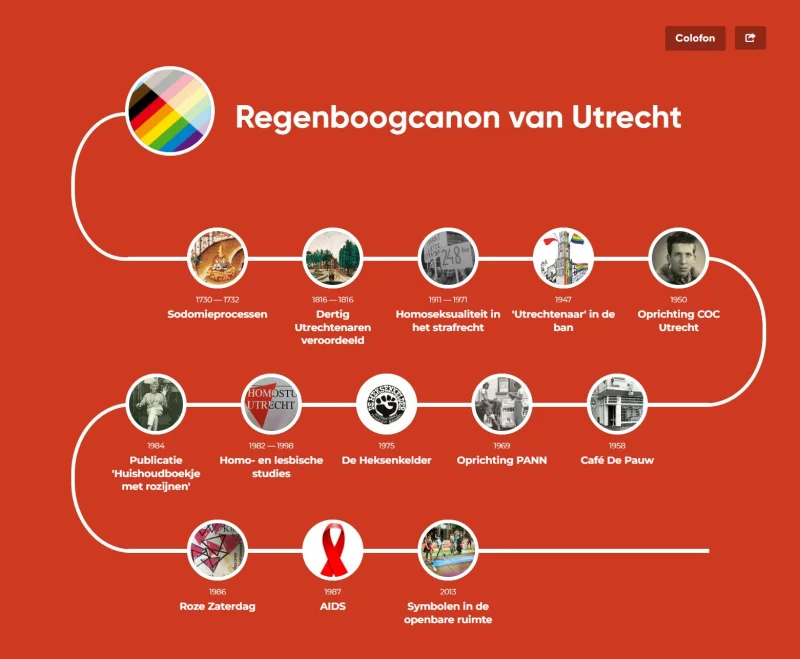
UTRECHT – The official historical record of the Netherlands has been updated to include a dedicated overview of Utrecht's LGBTQ+ history. The new 'Regenboogcanon' (Rainbow Canon) is the first of its kind to be integrated into the Canon of the Netherlands, the framework that guides history education in the country.
Developed by the volunteer collective Queer U Stories, the Rainbow Canon provides a structured timeline of key people, places, and events that have shaped the city's queer past. This inclusion formally places LGBTQ+ history within the broader narrative of both Utrecht and the nation, making it a standard resource for schools, museums, and the general public.
A Timeline of Struggle and Community
The canon is presented as a series of historical 'windows', each focusing on a specific moment or development. The timeline spans centuries, from dark periods of persecution to the establishment of vital community institutions. Highlights include:
- The Sodomy Trials (1730-1732): Acknowledging the nationwide persecution of homosexual men, which began with arrests at the Dom Tower in Utrecht.
- Founding of COC Utrecht (1950): The establishment of a local chapter of the Netherlands' oldest LGBTQ+ rights organization.
- The PANN Parties (1969): The start of the popular and long-running parties for LGBTQ+ youth, which became a cornerstone of the social scene.
- De Heksenkelder (1975): The opening of a foundational women's and lesbian café and cultural space.
- Roze Zaterdag (1986): The hosting of the national Pride event in Utrecht.
- Symbols in Public Space (2013): Marking the installation of the city's first rainbow crosswalk, a visible symbol of inclusion.
An Important Recognition
The project aims to ensure that the stories of the LGBTQ+ community are not treated as a separate or niche topic, but as an integral part of Dutch heritage. "That the queer history of Utrecht is now part of the official canon is an important recognition," said Iris Bouman of the project. "It shows that these stories are inextricably linked to the history of Utrecht and of the Netherlands."
By formalizing this history, Queer U Stories and the Canon of the Netherlands provide a valuable and accessible tool for education and remembrance, ensuring that the contributions and struggles of past generations are not forgotten.
The full Regenboogcanon van Utrecht can be explored online on the Canon van Nederland website.