The film offers several points of analysis for LGBTQ+ audiences, from its historical nods to its modern interpretations of identity and community. Here is a look at the key queer elements present in the production.
A Legacy of Outsiders
The film is a direct homage to the 1935 classic Bride of Frankenstein, which was directed by James Whale, one of the few openly gay directors of Hollywood's Golden Age. Gyllenhaal appears to consciously adopt the camp aesthetic and focus on "outsider" status that characterized much of Whale's work. This is most evident in the central trio of Frank (Christian Bale), the Bride (Jessie Buckley), and the eccentric Dr. Euphronius (Annette Bening). Together, they form a 'found family' of social misfits, a concept that has long resonated within queer communities built outside of traditional heteronormative structures.
New Dimensions of Desire
Gyllenhaal's script introduces new layers of subtext concerning attraction and companionship. A significant plot point involves Frank's intense fascination with a charismatic song-and-dance man, Ronnie Reed (played by Jake Gyllenhaal). Frank's longing for a world of beauty and performance, filtered through his idolization of a male star, has been interpreted by critics as a homoerotic undercurrent to his quest for a companion.
Additionally, the character of the 'mad scientist' has been gender-swapped. Dr. Pretorius from the original film, often read as a queer-coded tempter, is now Dr. Euphronius, played by Annette Bening. She is portrayed as a 'mother of creation' who lives in a secluded domestic world with her maid, Greta (Jeannie Berlin). Some readings of the film suggest their relationship is a quiet, self-contained partnership between two women who have opted out of the patriarchal society around them.
The Body as a Canvas for Identity
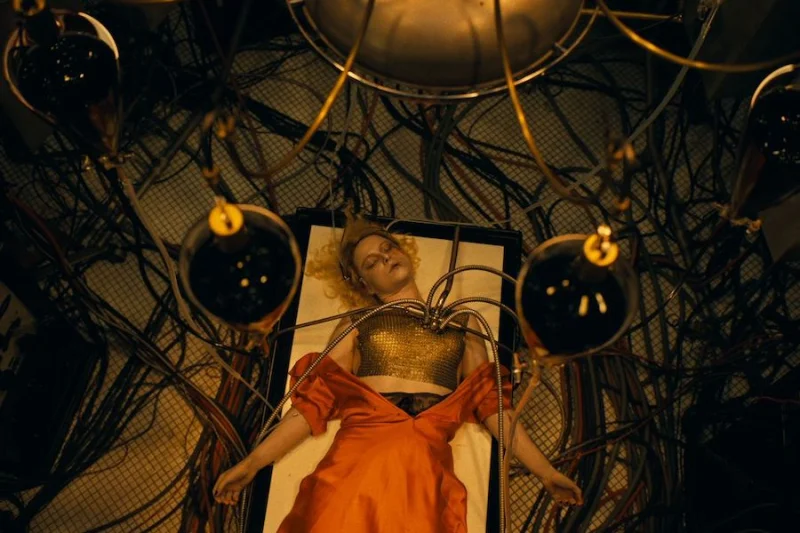
The film's visual language has also drawn comparisons to trans and gender non-conforming experiences. The Bride's journey is framed as a 'second birth,' where she must forge her own identity and name, actively rejecting the role of 'wife' that Frank attempts to impose upon her. The literal act of stitching a body together, combined with the Bride's distinct self-styled aesthetic of ink-stained lips and stark white hair, serves as a powerful metaphor for rejecting a 'natural' or assigned body in favor of one that is self-made and self-defined.
Sanctuary on the Dance Floor
A pivotal sequence takes place in an underground Chicago nightclub, a space depicted as a haven for the city's outcasts, including queer dancers. This 'Deprivation Disco' stands in stark contrast to the violent, mob-controlled world outside. It is within this queer-coded environment that the Bride experiences her first moments of genuine freedom and uninhibited joy, finding a sense of belonging among fellow outsiders. The scene functions as a clear nod to the historical role of nightclubs and bars as essential sanctuaries for the LGBTQ+ community.