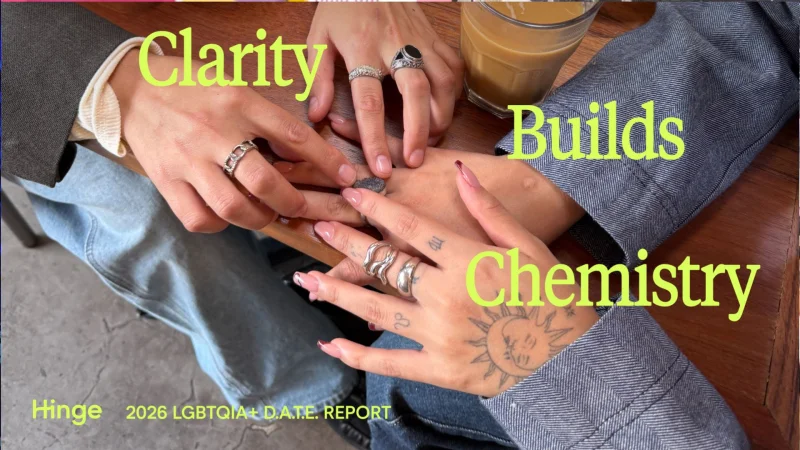
The report, titled "Clarity Builds Chemistry," surveyed over 31,000 daters worldwide and found that while a significant majority of LGBTQ+ respondents (76%) feel a great deal of uncertainty about the world, compared to 52% of heterosexual daters, they are also using this feeling to their advantage. Nearly three-quarters (74%) stated that this uncertainty helps them better understand what they are looking for in a relationship, allowing them to clarify preferences and identify dealbreakers more effectively.
A central finding of the study is the critical role of the 'friend test.' For the LGBTQ+ community, where the concept of a 'chosen family' (gekozen familie) is often fundamental, a partner's acceptance by friends is a major consideration. Key statistics highlight this shift:
- Queer daters are 33% more likely than their straight counterparts to say it matters that their friends approve of the person they are dating.
- For trans daters, this figure rises to 37%.
- LGBTQ+ singles are also 20% more likely to want to assess if a potential partner will mesh with their friend group before committing further.
The Search for Stability and Safety
This desire for clarity extends beyond social circles and into the mechanics of dating itself. The report indicates that consistency is a powerful tool for reducing anxiety in the early stages of a relationship. A large majority of LGBTQ+ daters (86%) feel less anxious with consistent communication, while 78% said that making clear, definite plans helps ease their minds—a notably higher figure than the 56% of heterosexual daters who said the same.
Public displays of affection (PDA) present a complex picture. While 65% of queer daters report that PDA helps them feel more secure in a new relationship, they are also 50% more likely than straight daters to hesitate before showing affection on a first date due to concerns about their physical safety. This highlights an ongoing reality for the community, where a moment of connection can also be a moment of vulnerability.
Moe Ari Brown, Hinge's love and connection expert, advises open communication to navigate this. "Asking one another what kinds of affection feel good in public—and which feel better in private—keeps PDA grounded in reassurance," Brown noted in the report.
A Mindset, Not a Timeline
The study also shows a departure from traditional relationship timelines. More LGBTQ+ daters (76%) and an even higher percentage of bisexual daters (83%) prefer to focus on slowly building a connection rather than adhering to a predetermined schedule for milestones. For many, settling down is viewed less as a sequential step and more as a state of mind, achieved when the connection feels right, secure, and supported by their community.
These findings suggest a significant evolution in dating priorities within the LGBTQ+ community, moving away from ambiguity and towards intentional connections built on a foundation of clarity, communication, and the vital support of a chosen family.