A new 26-country Ipsos survey shows attitudes have stopped sliding after years of backlash. The Netherlands still tops the charts on marriage equality — but it's not all rainbows.
Every June, polling giant Ipsos takes the world's temperature on LGBT+ acceptance. This year's Pride Report, based on interviews with over 19,000 people across 26 countries, lands in the middle of a WorldPride summer in Amsterdam — and it comes with cautiously good news.
After several years of what Ipsos itself calls a “wokelash” — declining support on almost every measure since 2021 — attitudes have stabilised. Most numbers are flat or slightly up compared to last year. The free fall seems to be over. The recovery, though, hasn't really started.
The world in 2026: steady, but split
Some of the report's key global findings:
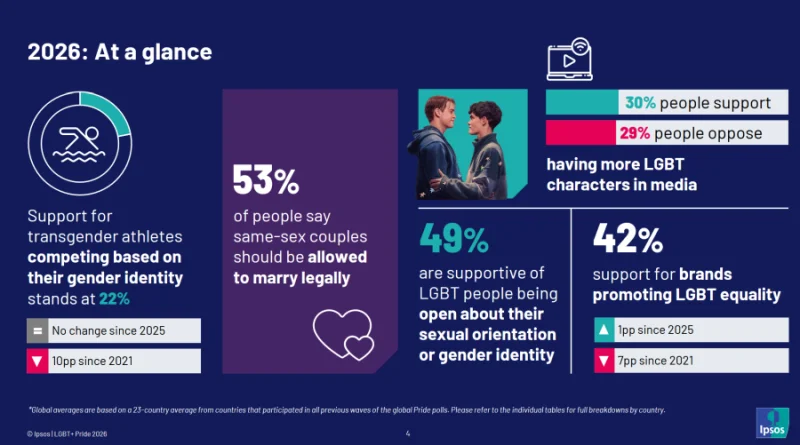
- Same-sex marriage remains a cornerstone of acceptance. Across 23 countries, 53% say same-sex couples should be allowed to marry legally. Support is strongest in Europe — and lowest in Poland (33%) and Türkiye (16%).
- Most people agree queer people deserve protection. 75% say lesbian, gay and bisexual people should be protected from discrimination in employment and housing; 73% say the same about trans people. That's about as close to global consensus as this survey gets.
- Rainbow capitalism is losing its shine. 42% support brands actively promoting LGBT equality — stable since last year, but well down from 49% in 2021. People haven't turned against queer rights; they've cooled on companies wearing them as a logo.
- Trans rights are where the world splits. Almost everyone agrees trans people face discrimination (65% say a great deal or fair amount). But on policy — sports, single-sex spaces, healthcare — opinions keep sliding. Support for trans athletes competing based on their gender identity has dropped from 32% in 2021 to just 22% now, with opposition the majority view in nearly every country surveyed.
- Media representation divides opinion almost perfectly. 30% want more LGBT characters on TV, in films and in ads; 29% are against. Support ranges from 59% in Thailand to 14% in South Korea.
Zoom in: the Netherlands
The country that invented marriage equality 25 years ago still leads on it: 80% of Dutch respondents say same-sex couples should be allowed to marry — the highest score of all 26 countries. Add those who back civil unions instead, and only 5% want no legal recognition at all.
And after years of decline, the Dutch numbers are ticking up again. Compared to 2025:
- Support for LGBT people being open about who they are: 58%, up from 52%
- Support for laws banning anti-LGBT discrimination: 61%, up from 55%
- Support for openly LGB athletes: 65%, up from 60%
- 81% agree LGB people should be protected from discrimination; 77% say the same for trans people
The Netherlands also tops one more list: 76% of Dutch people say trans people face real discrimination in their country — the highest of any country surveyed. Awareness, at least, is not the problem.
But before we get too smug: almost every Dutch number is still well below 2021. Support for brands promoting equality sits at 51%, down from 64% five years ago. Backing for more queer characters in media has slumped from 44% to 33%. And on trans policy, the Netherlands looks surprisingly average: only 23% support trans athletes competing by gender identity, 46% back gender changes on passports, and 45% think health insurance should cover transition care.
In other words: the Dutch love the marriage, but the conversation about trans lives is as unfinished here as everywhere else.
Why it matters
The big takeaway from Ipsos 2026 is that the backlash has a ceiling. People haven't abandoned queer rights — global majorities still support protection from discrimination, and openness keeps inching up. But the era of automatic, year-on-year progress is over, and trans rights have become the fault line.
For the Netherlands, hosting the world this WorldPride summer, the report is both a badge of honour and a homework assignment.
The Ipsos LGBT+ Pride Report 2026 surveyed 19,019 adults in 26 countries between 24 April and 8 May 2026 via its Global Advisor online platform. Global averages are based on the 23 countries that took part in all previous waves. Full report: ipsos.com