
26
Jul
A monthly Lazy Queer Sunday focusing on queer history, featuring discussions on the play 'The Mad Sexton of the Dom Tower' and the book 'Queer History of the Netherlands'.
Lazy Queer Sunday: Mad Sexton of the Dom Tower X Queer History of the Netherlands
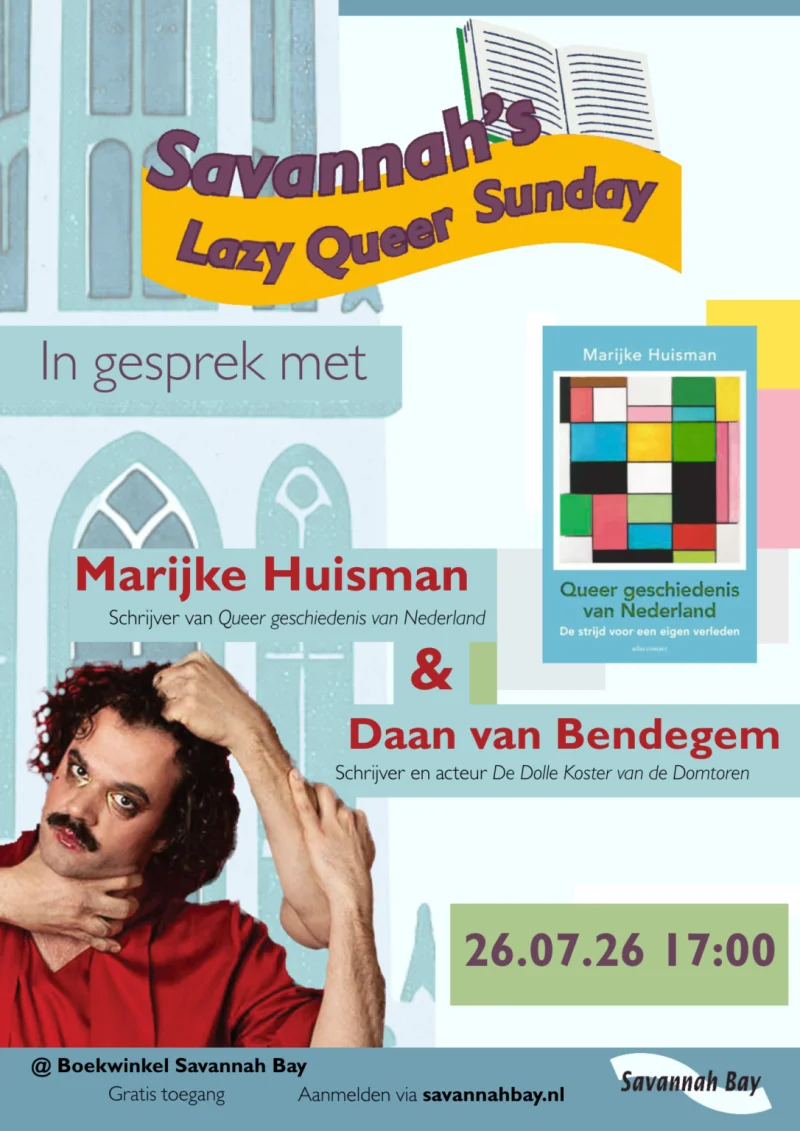
Join us for a dive into queer history at our monthly Lazy Queer Sunday! This edition features a spotlight on the play 'The Mad Sexton of the Dom Tower' and a discussion with Marijke Huisman about her book 'Queer History of the Netherlands'.
We will talk with actor/writer Daan van Bendegem from Compagnie Red, Yellow & Blue and theater group Aluin about their latest performance. It takes you to Utrecht in the summer of 1729, where two men are caught making love in the chapel of the Dom Tower: the beginning of the Sodomite persecutions. What can be the consequences of intolerance, homophobia, and having a blind spot?
Marijke Huisman will also talk about her book, a new, inclusive history of the LHBTIQ movement in the Netherlands that shows how queer people and activists have repeatedly written and rewritten their own history.
Who or what is this queer history actually about, or who should it be about? What lies behind us, where do we stand now, and where are we going? Come listen and join the conversation about queer history, present, and future.
About the Play: The Mad Sexton of the Dom Tower
Utrecht, the summer of 1729. In the chapel of the Dom Tower, the sexton catches two men making love. To divert attention from his own misdeeds, he points to the men as sinners and betrays them. His cowardly act marks the beginning of a hunt for homosexual men to be tried for their love: the Sodomite persecutions.
Nearly three centuries later, we return to where it all began. In the St. Michael's Chapel in the middle of the Dom Tower, Theatergroep Aluin and Compagnie Red Yellow & Blue present: The Mad Sexton of the Dom Tower. A fast-paced history lesson and a razor-sharp black comedy in one.
About the Book: Queer History of the Netherlands
This new, inclusive history of the LHBTIQ movement in the Netherlands shows how queer people and activists have repeatedly written and rewritten their own history.
In 2001, the Netherlands was the first country in the world to open civil marriage to same-sex couples. The emancipation of sexual minorities was complete, or so it was thought, but nothing could be further from the truth. Sexual freedom and diversity became focal points in discussions about national identity, yet the rich LHBTIQ+ history was not included in the Canon of the Netherlands.
Marijke Huisman highlights the work that LHBTIQ+ activists themselves have done to make their 'own' history visible and anchor it in the collective memory.
Boekwinkel Savannah Bay
Telingstraat 13, Utrecht, Netherlands
Queer Places Nearby
Upcoming
Telingstraat 13, Utrecht, Netherlands
Queer Places Nearby
Wijncafé Lefebvre
Bar in Utrecht
Bar in Utrecht
The 5th | Utrecht
Restaurant in Utrecht
Restaurant in Utrecht
U-Bar
Bar in Utrecht
Bar in Utrecht
Upcoming
LGBTQIA+ Book Club Amsterdam August: Manhunt by Gretchen Felker-Martin
Wednesday, 05-08-2026, 20:00, Amsterdam
Wednesday, 05-08-2026, 20:00, Amsterdam