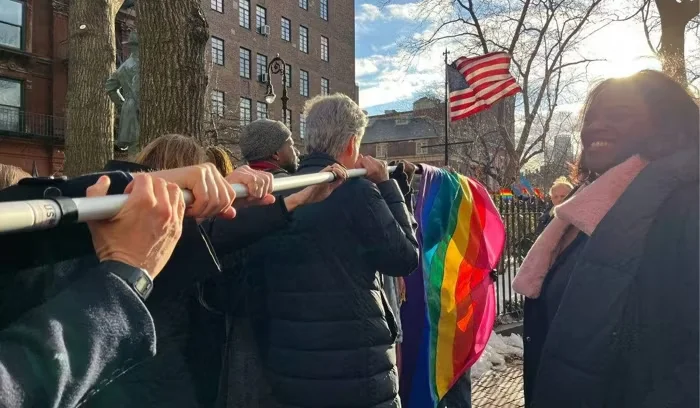
NEW YORK – This was never going to be a quiet, dignified ceremony. When New York's political class arrived at the Stonewall National Monument on Thursday, they intended to lead a symbolic re-raising of the Pride flag, a tidy response to its removal by the Trump administration two days prior. They brought a flag, made speeches, and posed for cameras. But the thousand-strong crowd that flooded Christopher Park had other ideas.
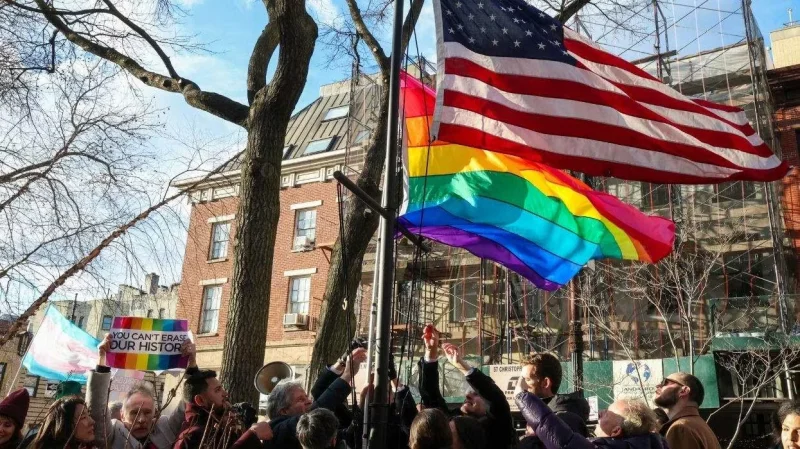
What was meant to be a display of unified resistance quickly fractured, exposing a deeper tension. The community wasn't just angry at Trump; they were fed up with sanitized, politician-led gestures. As officials attempted to hoist the Pride flag on a makeshift pole beneath the newly-installed American flag, the crowd’s frustration boiled over. Chants of “Our flag only!” and “Raise our flag!” drowned out the speeches. The politicians, including State Senator Erik Bottcher and HRC President Kelley Robinson, were pushed to the margins by a wave of raw, grassroots anger.
This wasn't a rally. It was a reclamation. The crowd saw the American flag, which had not flown there before, as an intrusion. They saw the politicians' careful maneuvering as cowardice. And in a scene echoing the very history of the ground they stood on, they took matters into their own hands.
A Calculated Insult, An Unfiltered Response
The confrontation was sparked earlier in the week when the National Park Service, on orders from the Trump administration, removed the Pride flag that had long flown over the monument. The official reason was a bureaucratic adherence to “federal flag policy,” but no one was fooled. It was a deliberate act of erasure, part of a broader political campaign against queer visibility.
“They’ve come for our books, our existence, and even pulled down our flag,” said Kelley Robinson of the Human Rights Campaign. “Two days is too long for the flag to be down, so we came out, and we put it back up ourselves.”
But the community's definition of "putting it back up" differed starkly from the official plan. As the politicians fumbled with their temporary solution, activists breached a fence. One pulled down the politicians' flag, cut it from its pole with a knife, and worked with others to lash it directly to the main flagpole. The crowd roared. For a moment, it was chaos. Then, a chant began to ripple through the park: “This is what democracy looks like.”
A Global Warning
For those of us watching from the Netherlands and across Europe, the events at Stonewall are more than just American political drama. They are a stark reminder that our hard-won symbols and spaces are never permanently secure. The strategy of using bureaucratic rules to enforce ideological erasure is a tactic employed by right-wing movements globally. An attack on Stonewall—the literal birthplace of the modern Pride movement—is an attack on the global queer community's shared history.
The protesters' rejection of a compromised, state-sanctioned symbol in favor of their own is a powerful lesson. It demonstrates that when institutions fail us, the spirit of direct action that defined the 1969 uprising is not just history; it's a living, breathing necessity.
'Stonewall Started as a Riot'
In the end, after a tense struggle, both the Pride flag and the U.S. flag were left flying side-by-side, whipped by a vigorous wind. It wasn't the neat resolution the politicians wanted, but it was an honest one—a visual representation of a community fighting for its place within a nation that is often hostile to it.
Marti Gould Cummings, a local Democratic committee member, framed the confrontation within its necessary historical context, noting that the fight over a flag is inseparable from wider efforts to erase queer and other marginalized histories. Stonewall, they reminded everyone, “started as a riot” and remains part of an unfinished struggle.
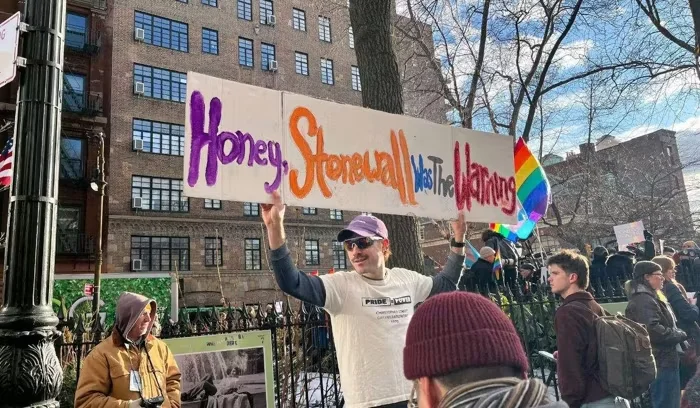
One protester’s handmade sign seemed to capture the mood of the day perfectly. It read: “Honey, Stonewall was the warning.” On Thursday, the community made it clear that it's a warning they are still willing to issue.