Image: ILGA-Europe
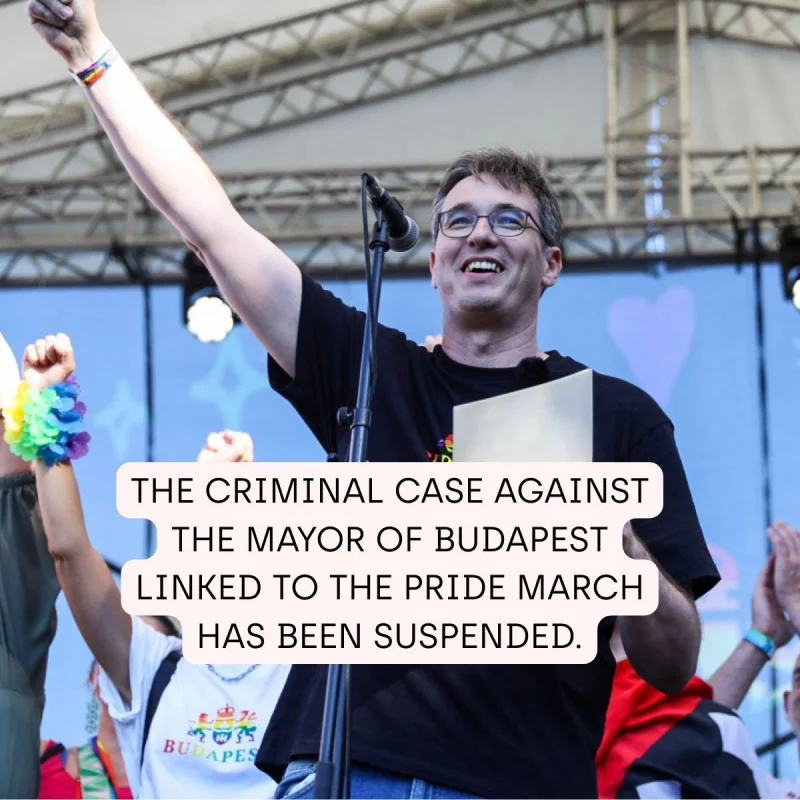
BUDAPEST - In a notable development for LGBTQ+ rights in Hungary, a court has suspended criminal proceedings against Budapest Mayor Gergely Karácsony over his role in facilitating last year's Pride march. The court has referred the controversial laws used to justify the case to Hungary's Constitutional Court, questioning their compliance with both the national constitution and the European Convention on Human Rights.
The case stems from the actions of Prime Minister Viktor Orbán's government, which has enacted a series of laws widely seen as targeting the LGBTQ+ community. The legal challenge against Mayor Karácsony is a direct consequence of these measures.
A Legal Chess Match Over Pride
The issue began after the Orbán government amended Hungary's assembly law, a move that followed the passage of a 2021 law banning the "promotion" of homosexuality and gender transition to minors. The amended assembly law stipulated that public gatherings must not infringe upon the protection of minors, effectively creating a legal pretext for police to ban Pride events.
In response, Mayor Karácsony employed a creative strategy for the Budapest Pride on June 28, 2025, which drew a record crowd of approximately 200,000 people. By declaring the parade an official city-organized event, he moved it outside the jurisdiction of the restrictive assembly law. This allowed the march to proceed despite the government's clear intent to prevent it.
However, the public prosecutor's office, led by figures loyal to Orbán, initiated criminal proceedings against Karácsony for his actions. The prosecutor sought a simplified process resulting in a fine, which would have avoided a public trial.
Court Raises Constitutional Doubts
Instead of rubber-stamping the prosecutor's request, the Pest District Court took a different path. It paused the case and escalated the matter, expressing significant doubts about the legal foundation of the charges. The court has now asked the Constitutional Court to examine both the amended assembly law and the 2021 "propaganda" law.
The referral raises several key legal questions:
- Does the legislation disproportionately restrict the fundamental right to freedom of assembly?
- Do the laws unlawfully discriminate against members of the LGBTQ+ community?
- Is the language of the laws sufficiently clear and defined, or is it overly broad?
- Do the laws violate Hungary's commitments under the European Convention on Human Rights?
What Happens Next?
The Constitutional Court now has 90 days to deliver its ruling. Its decision will be a critical moment for civil liberties and LGBTQ+ rights in Hungary. A ruling against the laws could invalidate the legal basis for restricting Pride and similar events, representing a significant setback for the Orbán government's anti-LGBTQ+ agenda.
ILGA-Europe, a leading European LGBTQ+ advocacy organization, welcomed the news. "We now hope the Constitutional Court will carefully examine the law in light of Hungary’s constitutional obligations, international human rights commitments and EU law," the organization stated. The case is being closely watched across Europe as a test of the rule of law and democratic protections within an EU member state.