Read the full overview article
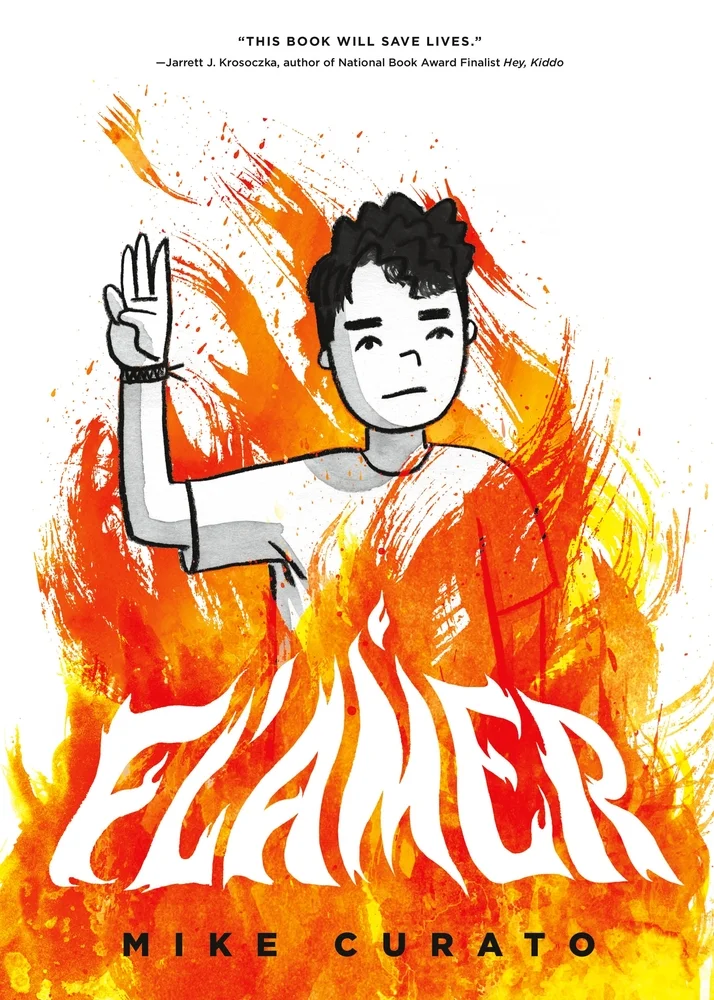
Mike Curato's debut graphic novel, Flamer, is a semi-autobiographical story set in the summer of 1995. It follows Aiden Navarro, a Filipino-American boy navigating the turbulent period between middle school and high school at a Boy Scouts summer camp. While dealing with relentless bullying, complicated friendships, and a burgeoning crush on his tentmate, Elias, Aiden grapples with his own identity and the intense weight of the word 'gay'.
The novel captures the internal conflict of a young person struggling with self-acceptance, encapsulated in Aiden's own thoughts: "I know I’m not gay. Gay boys like other boys. I hate boys. They’re mean, and scary... I hate that word. Gay. It makes me feel... unsafe." Curato uses a stark black, white, and orange-red color palette to illustrate Aiden's journey, which touches on themes of racism, body image, faith, and suicidal ideation with a raw honesty that has resonated with many readers.
Widespread Acclaim Meets Coordinated Opposition
Upon its release in 2020, Flamer received significant critical acclaim. It won a Lambda Literary Award and was featured on numerous 'Best of the Year' lists, including those from NPR, Kirkus Reviews, and the School Library Journal. Reviewers praised its nuance and emotional depth, with author Jarrett J. Krosoczka stating, "This book will save lives." NPR noted that Curato "knows [boys] like Judy Blume knows a teenaged girl," highlighting its authentic portrayal of adolescent struggle.
Despite this praise, or perhaps because of it, Flamer has become one of the most frequently challenged books in American school libraries. The source of the challenges often stems from accusations that the book is pornographic or sexually explicit, claims that supporters say misrepresent the content. The Comic Book Legal Defense Fund notes that these challenges are part of a wider trend targeting LGBTQ+ stories.
The Front Lines of Censorship
The efforts to remove Flamer from shelves have taken various forms across the US:
- In Katy, Texas, a parent filed a criminal complaint against the school district for providing "harmful material" to minors. Though law enforcement found the claim unsubstantiated, the book was temporarily removed and held by the police department.
- In Austin, Texas, the Eanes Westlake School District opted for a compromise, keeping the book in middle school libraries but requiring parental permission for 6th and 7th graders to check it out.
- The book's inclusion on the controversial "Krause List," a list of over 800 books targeted for removal by a Texas politician, has fueled challenges nationwide.
Supporters, like those in the Wentzville School District, argue that the book is highly relatable for its target audience. They contend that its depiction of struggles with self-esteem, bullying, and sexuality, culminating in a positive outcome, offers a message of hope to young readers who may feel isolated.
While large-scale, politically motivated book-banning campaigns are a phenomenon more specific to the current US climate, the debates over what constitutes 'appropriate' literature for young people are global. The story of Flamer serves as a clear example of how deeply personal stories of queer identity can become politicized, and the ongoing fight for representation on library shelves.