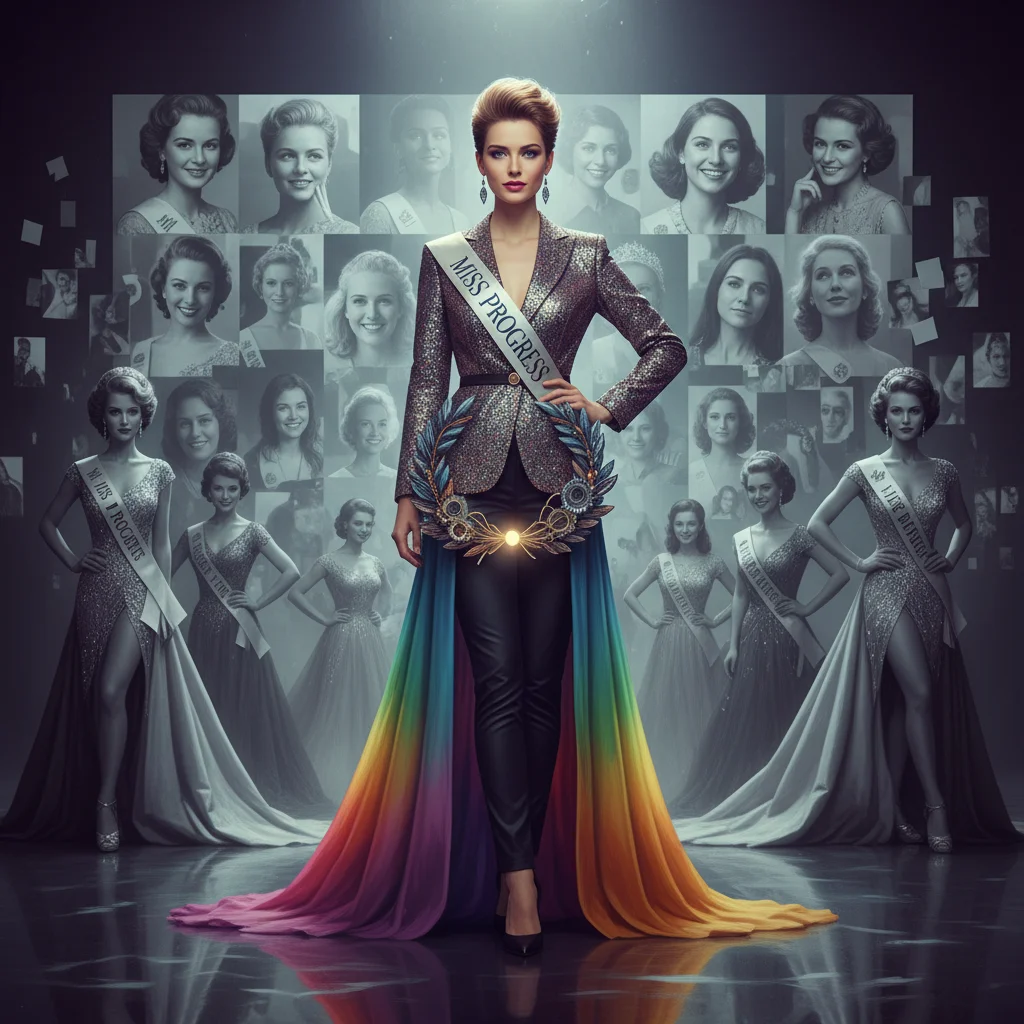
Is this what progress looks like?
The headlines were everywhere last week: Grace Richardson, 20, was crowned Miss England, immediately celebrated by the media as the pageant's "first openly lesbian" winner. On the surface, it feels like a moment for the history books, a clear win for LGBTQ+ representation. But as the confetti settles, a familiar, nagging question arises for many in our community: Is this really the progress we've been fighting for, or is it something else entirely, asks Lotte Jeffs in The Independent.
While we can certainly be happy for Richardson on a personal level—especially given her history of facing homophobic bullying—it's crucial that we look critically at the narrative being presented. Are we celebrating liberation, or are we celebrating assimilation in a ballgown?
Let's Retire 'Openly Gay'
First, let's talk about those two little words that refuse to go away: "openly gay." Why, in this day and age, is this prefix still attached to us as if it's a necessary clarification? Nobody introduces their "openly straight" friend at a party. The term, however well-intentioned, frames our identity as a disclosure, a piece of information that needs to be announced for the comfort of a presumed straight world. It reinforces the very idea that straightness is the default and queerness is the deviation.
As actor Andrew Scott pointed out, the phrase should be "parked" altogether.
"You are never at a party and you say, ‘This is my openly gay friend.’ You don’t say you’re openly Irish. You don’t say you’re openly left-handed. Why do we put ‘openly’ in front of that adjective?"
His point is sharp: there's an uncomfortable undertone to the phrase, as if being visible without shame is still a remarkable act that requires a special qualifier.
The Gilded Cage of 'Firsts'
This isn't just about language; it's about the institutions doing the 'accepting'. The Miss England pageant, for all its modern gloss, is still a bastion of traditional, often narrow, ideals of femininity and womanhood. Crowning a lesbian winner and declaring it a landmark victory feels less like a revolution and more like the institution congratulating itself for finally letting one of us in.
It’s a pattern we saw just weeks ago when Jonathan Bailey was named People's 'Sexiest Man Alive' and immediately branded 'the first openly gay man' to hold the title. These moments often say more about the institution's long history of exclusion than they do about genuine, radical inclusion. It turns our identity into a novelty, a marketing angle for an old system trying to appear relevant.
And this isn't just a UK phenomenon. We see similar dynamics here in the Netherlands. Headlines often rush to celebrate the 'eerste openlijk homoseksuele' person in a particular role, framing our visibility as a gift bestowed by the mainstream, rather than a fundamental right we already possess.
Where Should Our Energy Go?
The celebration around Richardson’s win feels hollow because her identity is being used to modernize an institution that remains fundamentally out of step with the world many of us are trying to build. An "openly gay" person being embraced by the mainstream is often queerness made safe, palatable, and stripped of its radical potential.
Meanwhile, the queer communities doing the most urgent and life-changing work—in the fight for better trans healthcare, safe housing for queer youth, and true social justice—rarely receive this kind of fanfare.
True progress isn't about being the 'first' one allowed into their room; it's about building a world where we don't need their validation in the first place. Let's focus our energy and our applause there.
Read the original opinion piece by Lotte Jeffs in The Independent.