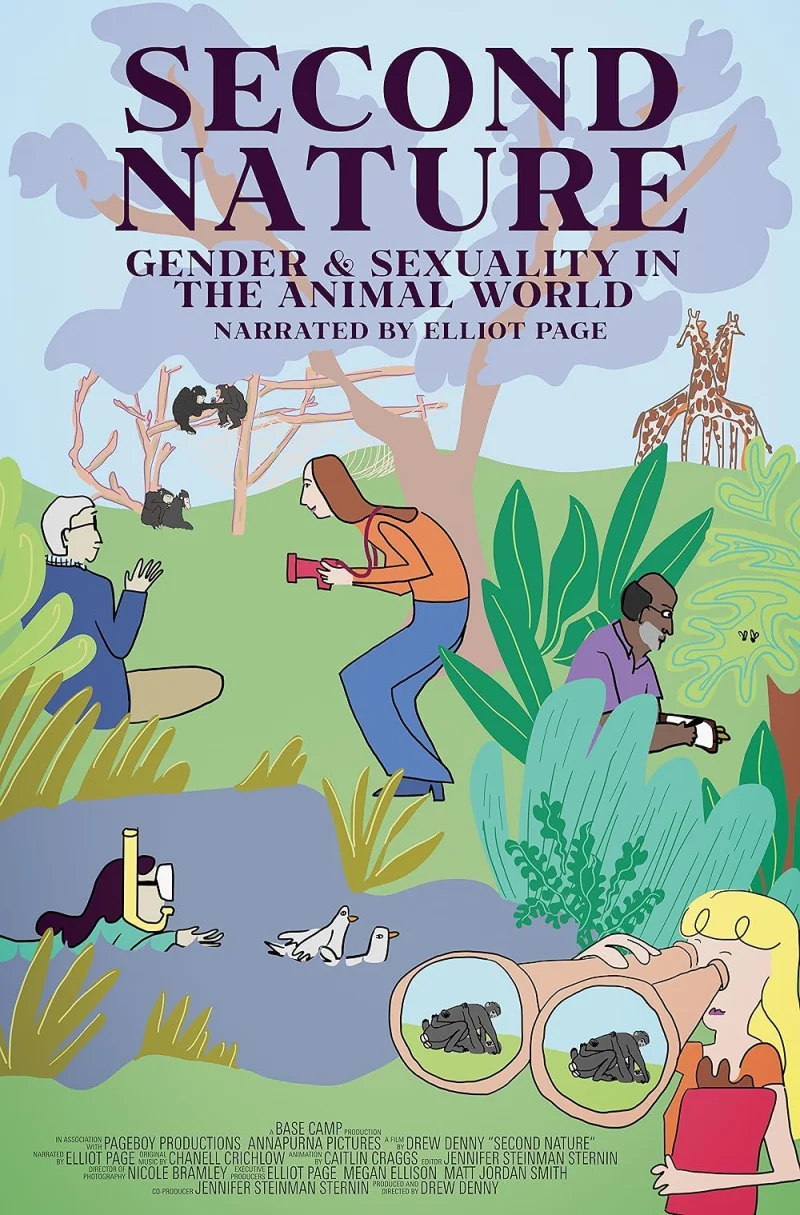
Actor and producer Elliot Page is lending his voice to a new documentary that challenges long-held assumptions about what is 'natural' when it comes to gender and sexuality. The film, titled Second Nature, argues that queerness is not an anomaly but a recurring and normal feature of life on Earth.
Narrated by Page, the documentary moves beyond simplistic biological frameworks that are often taught in schools. It showcases a range of behaviours in the wild that defy rigid human categories, such as same-sex penguin couples raising young, clownfish that change their sex, and bonobos that use sexual contact for social bonding and conflict resolution. The film argues that these are not exceptions, but rather integral parts of life's vast spectrum.
The documentary's scientific foundation is largely built on the work of Dr. Joan Roughgarden, a transgender evolutionary biologist at Stanford University. Her book, Evolution’s Rainbow, is a key text that questions traditional scientific views on sexual selection and the supposed universality of heteronormativity. The film presents her argument that "nature abhors a category" and that the gender binary is a human construct, not a biological absolute.
A Timely Counter-Narrative
The release of Second Nature is particularly timely. In the United States, the term 'biology' is frequently invoked by conservative lawmakers to justify legislation targeting the transgender community, from healthcare bans to bathroom access restrictions. While the film focuses on the American political context, its message resonates in Europe, where similar arguments are used by right-wing groups to oppose LGBTQ+ rights. The documentary serves as a counter-narrative, using scientific evidence to dismantle these essentialist claims.
In an interview, Page commented on this, stating, “I’d love for people to sit with just sort of the level of indoctrination that’s gotten you so stuck to these views that actually just simply aren’t factually true.”
Beyond its biological examples, the film also offers a critique of scientific history. It highlights how generations of researchers often observed, but failed to report on, or outright dismissed, diverse sexual and gender expressions in animals. These findings frequently contradicted prevailing cultural and religious biases, leading to what one scientist in the film calls “one of the best-kept secrets” in biology.
An Affirming and Playful Film
Director Drew Denny explained that the project was born from her own experiences growing up in a conservative environment where queerness was taught as unnatural. For Denny, discovering the scientific reality of diversity in nature was a profound personal affirmation. This feeling is one Page shares, stating in an interview that the project left him feeling “so affirmed” and that the information felt like an “obvious truth” he was surprised not to have known sooner.
According to early descriptions, Second Nature avoids a dry, academic tone. It is reportedly playful and humorous, discussing topics like “penis-fencing” bonobos and the complex genitalia of various species with enthusiasm. The film aims to be both educational and entertaining, making its scientific points accessible and engaging.
Ultimately, Second Nature suggests that the fear of uncertainty is what drives many to cling to rigid binaries. The film proposes that nature itself has never shared this fear, embracing diversity as a core principle of existence.