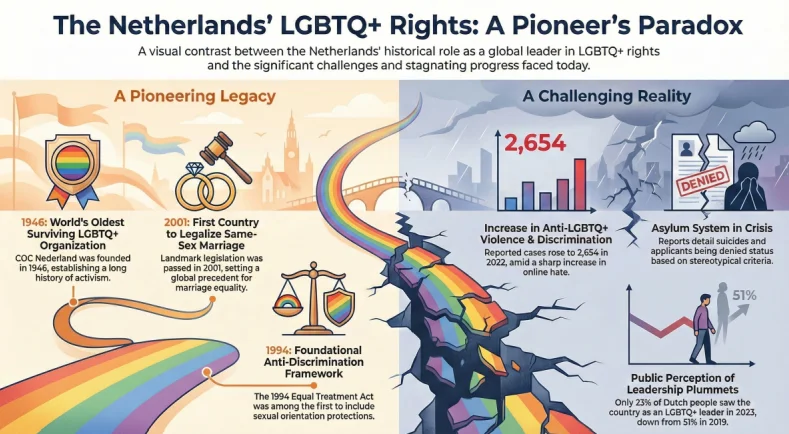
The Progressive Pioneer's Paradox
In 2001, the Netherlands cemented its global reputation as a pioneer in LGBTQ+ rights by becoming the first country in the world to legalize same-sex marriage. For decades, it has been viewed as a bastion of tolerance. But beyond the celebratory headlines and historical milestones, what is the lived reality for LGBTQ+ individuals in the Netherlands today?
Alarm bells first sounded in a 2022 report from the Dutch government's own social and cultural planning office (SCP), which noted a worrying stagnation in acceptance. Now, new qualitative research from Utrecht University gives a human voice to those alarming statistics. Based on eighteen in-depth, semi-structured interviews with members of the community, the study reveals a more complex and troubling picture, uncovering the "why" behind the numbers. This post explores four of the most impactful findings, offering a nuanced look at the state of LGBTQ+ acceptance in a nation confronting a paradox.
1. Progress Has Stalled—Especially in the Last Five Years
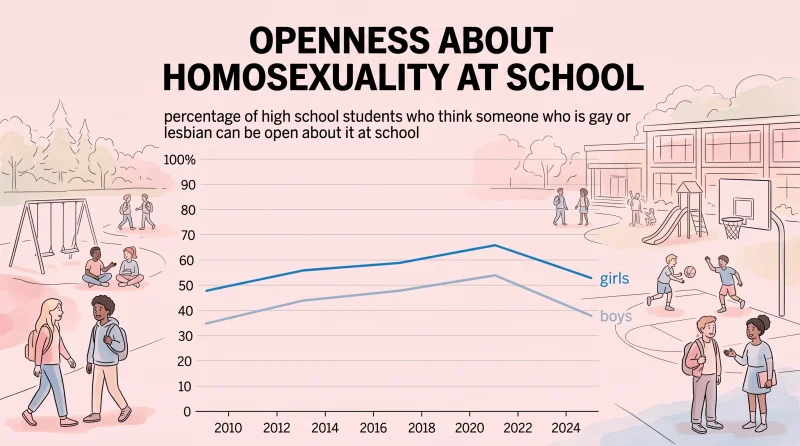
The study's primary finding is a stark one: while participants felt acceptance had generally grown over the last decade, they also reported a significant stagnation or even a decline in the last five years (2019–2024). This sentiment of stagnation or decline was unanimous among participants, a stark consensus from within the community.
This shared feeling suggests that the forward momentum that once characterized the Dutch LGBTQ+ rights movement has hit a wall. For a nation that prides itself on its open society, this signals a profound shift that is not yet reflected in its international reputation. Participants noted that these issues are often exacerbated outside of the progressive bubbles of major cities like Amsterdam, pointing to a more fractured and geographically dependent reality of acceptance.
2. The Rainbow is Divided: Acceptance Isn't Equal for Everyone
The research uncovers a clear and painful division within the LGBTQ+ community itself. While societal acceptance for gay, lesbian, and bisexual individuals is perceived as more established, that progress has also slowed, and it stands in stark contrast to the sharp decline or stagnation experienced by transgender, queer, and intersex (TQI+) individuals. This was not just an observation made by transgender and non-binary people; gay, lesbian, and bisexual participants also noted the growing disparity.
What this reveals is a dangerous fracturing of the very idea of "LGBTQ+ acceptance," where progress for some serves to mask regression for others. One participant’s perspective powerfully illustrates this fracture:
"Yes, I think people who are gay, lesbian, or bisexual are more accepted than those dealing with gender issues, like non-binary or transgender individuals. For example, media portrayals, like Anouk's comment about menstruation, show that gender issues are less accepted than being gay." (Respondent 9 – Bisexual woman)
For many trans individuals, the degree of acceptance is directly tied to the concept of "passing"—being perceived as the gender with which they identify. This creates a painful spectrum of visibility and vulnerability, as one transwoman shared:
"As a transwoman, the experience varied depending on my stage. Initially, during my social transition with shorter hair and without makeup, I stood out noticeably. People often stared and questioned my appearance." (Respondent 10 – Transwoman)
This internal division is not occurring in a vacuum; it is being actively inflamed by an increasingly hostile political climate.
3. Political Rhetoric is Fueling the Chill
The stagnation in acceptance is not happening by chance. The research directly connects it to a harsher political discourse, particularly from emerging right-wing parties that employ populist rhetoric. This "weaponization of gender," as critical theorists call it, disproportionately targets gender identity and is a key driver of the growing divide within the rainbow community.
By framing LGBTQ+ issues—especially trans rights—as a threat to societal norms, these parties contribute to a climate of hostility. The study highlights specific examples that have had a chilling effect:
- The political party FVD (Forum for Democracy) has campaigned against what it calls "Woke and LGBTQI propaganda" and "transgender propaganda in schools."
- The political party DENK used a 2023 campaign slogan, “Zullen we weer gewoon doen?” which translates to "Is it time to act normal again?", a phrase seen by many as a direct rebuke of LGBTQ+ visibility.
This rhetoric moves discussions away from rights and inclusion toward a narrative of cultural conflict, directly impacting the daily sense of safety and belonging felt by LGBTQ+ individuals.
4. Even in a "Progressive" Nation, Systems Are Failing
Beyond social attitudes and political speech, participants identified significant systemic failures that reinforce their feelings of non-acceptance. One of the most damning findings concerned the Dutch healthcare system, which is experienced by gender-diverse individuals not as a source of support, but as a profound institutional barrier.
The system is so broken that it forces some to lie about their symptoms just to meet the rigid and outdated diagnostic criteria for gender dysphoria to access care. The bureaucratic and emotional toll is immense, as captured in the testimony of one trans non-binary participant:
"When I came out at 18 or 19, I registered with Stepwork through my GP, but they went bankrupt. They promised to put me on another waiting list, but that never happened. Depressed, I turned to the VU but never heard back. Why are transgender care wait times so long? Why do I need court involvement to change an X in my passport? And why is it such a hassle to change passport letters?" (Respondent 2 – Trans non-binary)
Furthermore, participants noted that despite a 2020 law mandating education on LGBTQ+ topics, proper implementation is still lacking in many schools. The research suggests a more effective path would be to integrate these topics into existing subjects like history and biology, rather than treating them as a separate, easily marginalized lesson. These institutional failures demonstrate how broken systems can undermine an individual’s sense of dignity, regardless of public opinion.
Conclusion: Looking Beyond Tolerance
The Netherlands' long-standing reputation for tolerance is being tested. The lived experiences of its LGBTQ+ community paint a picture not of a finished project, but of a complex reality defined by stagnation, internal division, hostile political winds, and failing systems.
As the Netherlands confronts these difficult truths, the path forward isn't about reclaiming a past reputation, but about building a genuinely inclusive future for all members of its rainbow community. The crucial question remains: How can a nation known for pioneering tolerance address the deep-seated political and systemic issues that are now coming so clearly to light?