
07
Nov
An interdisciplinary program featuring ten practitioners from different dance and body traditions sharing thirty-minute classes in a continuous, durational format.
Small Miracle #6: Dances
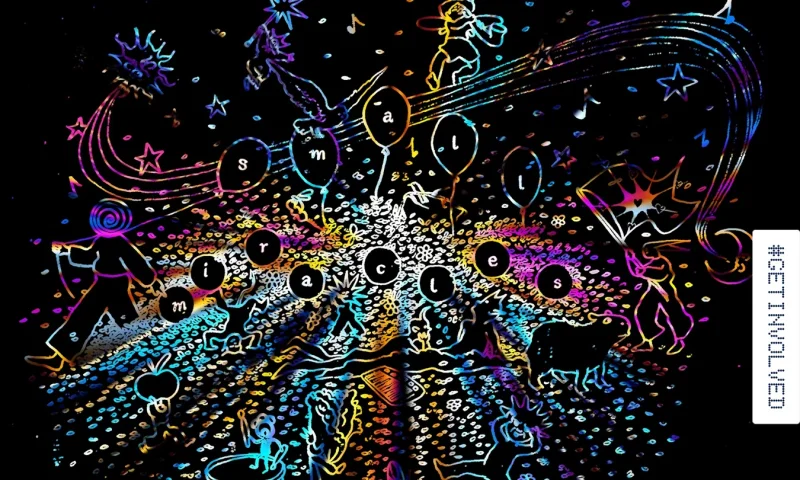
We invite you to explore what happens when different dance languages come into contact in our bodies, and how gestures, memories, and sensations accumulate through movement.
Tickets: € 10,- / Stadspas: €2,50
Small Miracle #6: Dances
We welcome you to the next Small Miracle, dedicated to the word Dances.
For this programme, we are inviting ten practitioners from different dance and body traditions and research practices to share a thirty-minute class or excercise with participants, each immediately followed by the next.
As different forms of dance tend to inhabit separate social spaces, classes, celebrations, and gatherings, they dont often coexist in close proximity. Through this format, we are interested in befriending them in space and time, allowing their gestures, rhythms, memories, and sensations to accumulate and enter into relation with one another through the bodies taking part.
Participants include:
- Toni Steffens
- Zaher Hamzat
- Ainhoa Hernández Escudero and Aion Arribas
- Raoni / Muzho Saleh
- Teresa Jaldón
- Junadry Leocaria
- nisha ha
- Dayna Martinez Morales
- La Uyi
- Fernanda Libman
About Small Miracles
Small Miracles is a series of interdisciplinary programs, part of the Plein Theater program for co-creation, that tend to the existing and possible communities of Plein Theater. Taking place across different Saturdays throughout the year, the series brings together diverse artistic practices in extended, durational formats.
Each Saturday is dedicated to a word—or a word-mode—that serves as an invitation to explore the possibilities a theater offers for coming together. With a focus on desirable abundances and communal luxury, the programming of Small Miracles leans toward words aligned with these notions.
#GetInvolved
We believe that a theatre is not only a showcase platform, but also a meeting center where artists, local residents, communities, and audiences collectively shape what is presented. Our co-creation programme, where shared ownership and participation are key, can be recognised by the #GetInvolved label.
Are you a dancer who’d like to share your practice with us? Let us know! If you would like to participate, please contact Community Producer Lorenzo García Andrade (getinvolved@plein-theater.nl).
Biographies of participating artists:
Ainhoa Hernández Escudero makes performances, creates contexts and connections, and works as an artist, educator, curator, advisor, producer, and host in the cultural field. The core of their artistic practice lies in finding other ways of making sense by reimagining belonging and grieving inherited structures.
Dayna Martinez Morales is a Bolivian-born dancer, choreographer and performer whose work and practice moves between ritual and performance. Rooted in her Andean heritage and the ancestral ritual of Tinkuy of Nothern Potosi, she explores dance as an embodied encounter with the forces that move us beyond ourselves.
Fernanda Libman is a choreographer working at the intersection of movement, sound and spatial composition. Her research repeatedly brings her to investigate threshold states of perception in which meaning is becoming, shifting, losing its previous definition in response to affect and relationality.
Junadry Leocaria is an award-winning dance artist, choreographer, coach, teacher, and performer working at the intersection of theatre, Afro-Caribbean storytelling and urban dance. She specializes in waacking - an expressive form of club dance, set to disco music from the 1970s.
LA Uyi is a choreographer, stage performer and practitioner of physical theatre. Their main practice involves tracing folk myths, lores and mythologies from Northern Europe to West Africa and everywhere in between, using methods of Butoh, Drag, Waacking and Edo masquerade theory.
nisha ha is a choreographer and a performer who investigates how illness can be understood not only as an individual medical condition but as a collective and relational experience that connects people through care, empathy, and shared vulnerability.
Teresa Jaldón began her journey in flamenco dance at a very young age in her hometown, Huelva. In 2006, she founded her own school, FLAMENCOAMSTERDAM, through which she promotes her artistic and teaching work internationally.
Toni Steffens approaches dancing by enmeshing thinking, feeling, sensing and moving, aiming to develop ontologies that devices embodied knowledge as a tool to navigate political questions.
Raoni/Muzho Saleh is a Hazara Afghan/Dutch artist using performance, installation and the sound of moaning mourning to twist and reshape narratives of (cultural) becoming. His practice is engaged with the entanglement of body, spirit, politics and love within art.
Zaher Hamzat is a Palestinian choreographer and former professional stage dancer, born in Damascus, Syria. He leads workshops focused on traditional Levantine dances, particularly Dabke, as well as contemporary folk dance forms.
Plein Theater
Sajetplein 39, Amsterdam, Netherlands
Queer Places Nearby
Upcoming
Sajetplein 39, Amsterdam, Netherlands
Queer Places Nearby
Lola The Green Aardvark
Venue in Amsterdam
Venue in Amsterdam
We Are Queer - Amsterdam Oost
Gym in Amsterdam
Gym in Amsterdam
Café de Huyskamer
Bar in Amsterdam
Bar in Amsterdam
Upcoming