
07
Mar
This event has already passed.
Check out upcoming events on our homepage.
During the Queer Architecture bike tour, you will discover examples of queer architecture in Amsterdam. We will explore how architecture can reflect personal identity and what spatial solutions contribute to an inclusive city.
Bike Tour: Queer Architecture in Amsterdam
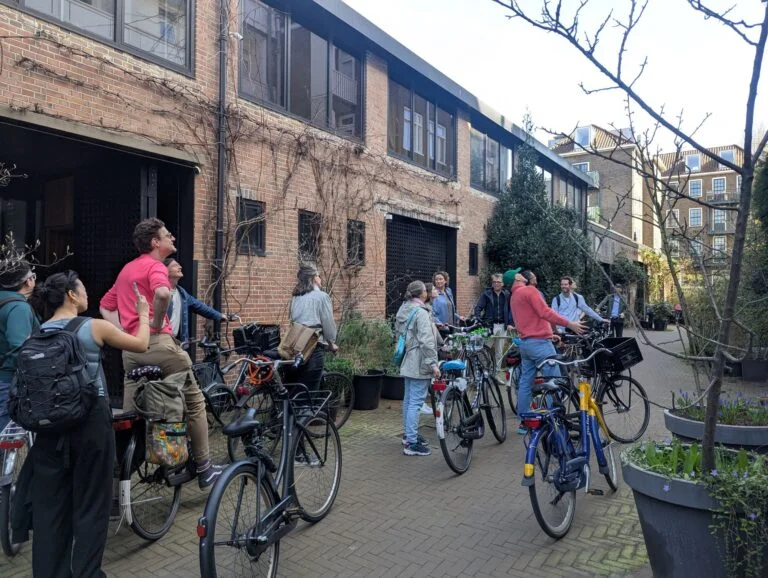
During the Queer Architecture bike tour, you will discover examples of queer architecture in Amsterdam. We will explore how architecture can reflect personal identity and what spatial solutions contribute to an inclusive city.
Amsterdam has long been known as the Gay Capital of Europe and is famous for its open culture and early acceptance of homosexuality. The diverse streetscape is still shaped by residents with various backgrounds and interests. But how do members of the LGBTIQ+ community live? Can they also shape their lifestyle behind their front door? Do they live in standard or unique apartments? And can architecture express personal identity?
Traditionally, homes in the Netherlands are designed with the classic nuclear family as the starting point. Floor plans often focus on a spacious master bedroom, combined with one or more smaller children's bedrooms. This design, however, does not always meet the needs of other forms of cohabitation, such as childless couples, single people, or households within the LGBTIQ+ community. For them, the question is whether standard housing forms offer enough space and freedom to express their lifestyle.
In an overheated housing market, where space is scarce and housing prices are high, it is increasingly important to find innovative solutions that meet these diverse housing needs. Are there, for example, flexible housing designs that can accommodate different lifestyles? How can architecture contribute to more inclusivity in the living environment?
Please Note:
- The tour will be conducted in English.
- This program is suitable for ages 18 and up only.
ARCAM
Prins Hendrikkade 600, Amsterdam, Netherlands
Queer Places Nearby
Upcoming
Prins Hendrikkade 600, Amsterdam, Netherlands
Queer Places Nearby
Latei
Bar in Amsterdam
Bar in Amsterdam
Café 't Mandje
Bar in Amsterdam
Bar in Amsterdam
San Francisco Bar & Club
Bar in Amsterdam
Bar in Amsterdam
Upcoming