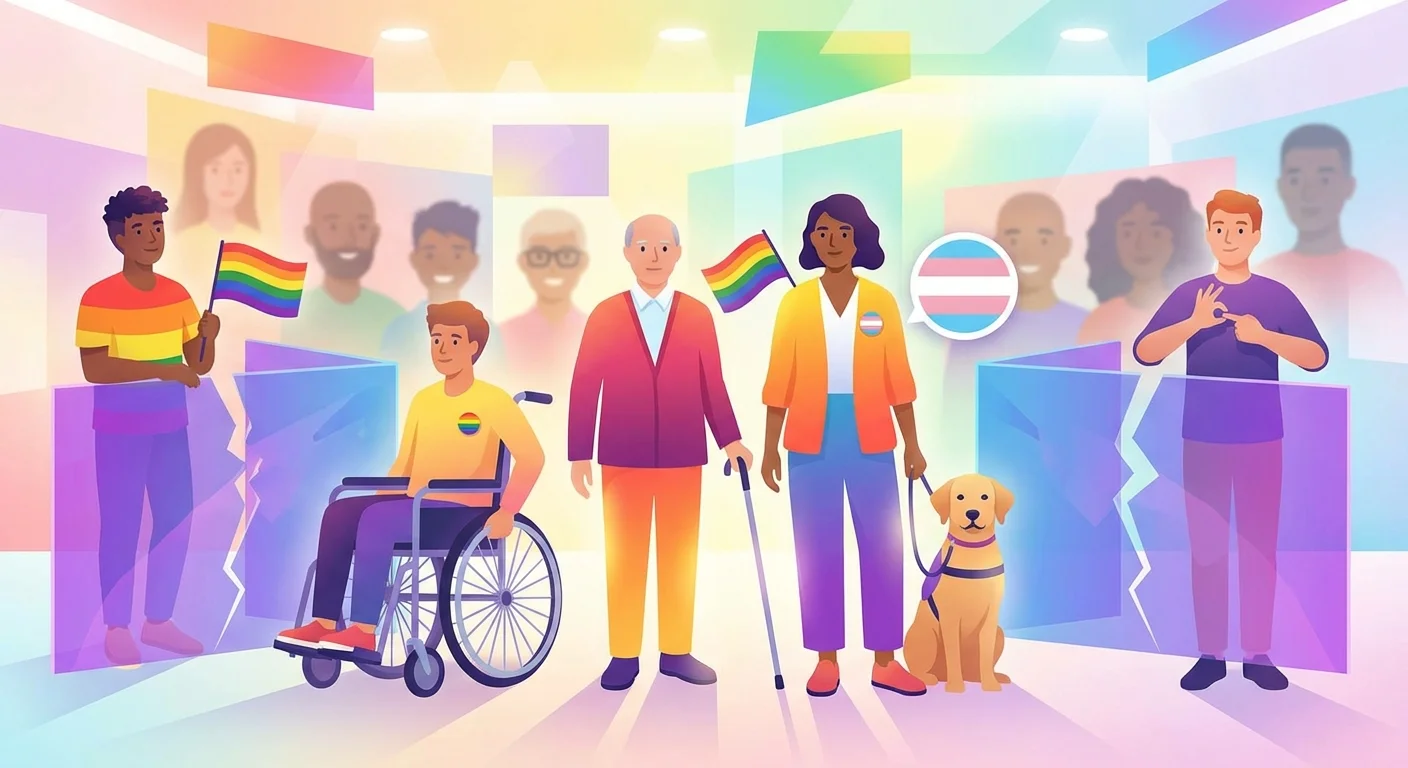
For many LGBTQ+ people with a disability, finding a true sense of belonging can feel like an impossible task. A new national report now puts hard numbers to this experience, and the findings are a wake-up call for the entire Dutch queer community. The Lhbtiqa+ Monitor 2024, for the first time, specifically investigated the lives of queer people with disabilities, revealing a group facing profound challenges not just from society at large, but from within our own spaces.
The statistics paint a grim picture. Compared to their non-LGBTQ+ peers, queer individuals with disabilities are:
- Financially struggling: 15% report having too little money, nearly double the 8% of the general population.
- Facing mental health crises: A staggering 33% are classified as psychologically unhealthy, compared to 16% of non-LGBTQ+ individuals.
- Targets of harassment: 19% experienced bullying or harassment in the last year, the highest of any group within the LGBTQ+ community and more than twice the rate of non-LGBTQ+ people (9%).
These numbers confirm what many have known for years: being queer and disabled in the Netherlands means navigating a world that often isn't built for you, and that includes the very community that should be a safe haven.
"You're Choosing to Not Welcome Us"
The report goes beyond statistics, using focus groups to uncover the lived realities behind the data. A central theme is the profound inaccessibility of LGBTQ+ events and spaces. This isn't just about wheelchair ramps; it's about a fundamental failure to consider the needs of all community members.
Participants described a frustrating catch-22: events for people with disabilities are often not queer-inclusive (using language like "ladies and gentlemen"), while queer events are frequently inaccessible. This can be physical, like a party in a basement bar with no elevator, or sensory, like a club with no quiet space for autistic or neurodivergent people to decompress.
"If you don't ensure a space is accessible, you're already choosing who is and isn't welcome. You are choosing to not welcome us."
This exclusion isn't just an oversight; the report's participants frame it as a form of discrimination. When event organizers fail to consider accessibility, they are actively filtering out a segment of their own community.
Ableism Under the Rainbow Flag
The report also confronts an uncomfortable truth: ableism exists within the LGBTQ+ community. Participants highlighted that they can face "double discrimination"—prejudice based on their disability and their queer identity, sometimes simultaneously.
One focus group member put it bluntly: "Being queer doesn't mean you can't be mean to people with a disability. That's often forgotten." This can manifest as social exclusion at events, dismissive attitudes, or a general lack of awareness that erases the experiences of disabled queer people.
This vulnerability is compounded for those who rely on caregivers. The report notes that a position of dependency can make it incredibly difficult to report inappropriate behavior or enforce personal boundaries, leading to a loss of bodily integrity and a higher risk of abuse.
What Can We Do? A Call for Action
The Lhbtiqa+ Monitor 2024 is not just a collection of problems; it's an implicit demand for change. While the source article offers tips for professionals, the message for us is simpler and more direct: we have to do better. This is a community-wide responsibility.
For Event Organizers & Venue Owners:
- Audit Your Accessibility: Go beyond the basics. Is your venue accessible for various physical disabilities? Do you offer a low-sensory space? Is information about accessibility clearly stated on all promotional materials?
- Communicate Proactively: Don't wait to be asked. State your accessibility features upfront and provide a contact for people to ask about specific needs.
For All of Us:
- Educate Ourselves: Learn about the challenges faced by disabled members of our community. Understand that accessibility is more than just physical access.
- Challenge Ableism: When you see it in our spaces—whether it's an inaccessible venue or a dismissive comment—speak up.
- Listen and Adapt: Center the voices of disabled LGBTQ+ people. Ask what they need to feel safe, welcome, and included, and then act on it.
Creating a truly inclusive community requires conscious effort. This report shows us where the gaps are. Now it's up to all of us to start closing them.