Understanding the Financial Leash on Local Government
With residents across the Netherlands preparing to elect new municipal councils, it's a critical time to understand what these local bodies can and cannot do. While council members debate local issues and set priorities for our cities and towns, their financial autonomy is significantly limited. The reality is that the national government in The Hague holds the purse strings, dictating the majority of municipal budgets.
An analysis of municipal finances shows a growing dependency on national funding. Currently, more than 72% of the money available to municipalities comes from the central government. This is a notable increase from 62% in 2020, highlighting a trend that gives national politics an ever-larger say in local affairs.
The Looming 'Ravine Year' and Temporary Relief
This dependency nearly led to a crisis. 2026 was dubbed the 'ravijnjaar' (ravine year), with a projected nationwide shortfall of €2.4 billion for municipalities. A primary driver of this deficit has been the rapidly increasing cost of youth care, a responsibility largely shifted to local governments. A last-minute intervention in the 2025 Spring Memorandum provided a temporary fix, with an extra €1 billion allocated for 2025 and additional funds for 2026 and 2027. However, this is merely a stopgap measure; experts warn that significant deficits are likely to reappear from 2028 onwards.
How the National Pie is Divided
The national government distributes funds primarily through the 'Gemeentefonds' (Municipal Fund). This is not a one-size-fits-all payment. The allocation formula is complex, considering factors such as:
- The physical size of the municipality.
- Whether it serves as a 'regional center,' attracting visitors from surrounding areas.
- The number of residents receiving social benefits.
- The local capacity to raise taxes (e.g., based on property values).
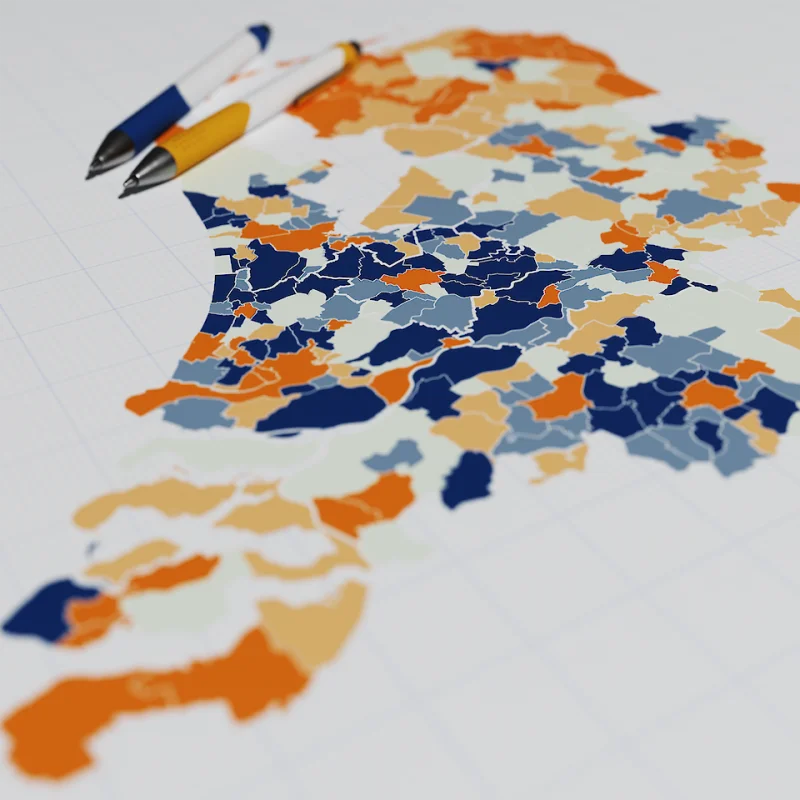
This system creates vast disparities in funding per resident. Wealthy municipalities with high property values, like Bloemendaal and Blaricum, receive less than €1,500 per inhabitant. In contrast, cities facing greater socio-economic challenges, such as Heerlen and Rotterdam, or unique circumstances, like the island of Schiermonnikoog, receive more than €4,000 per resident. These funds are often a mix of general payments and specific grants tied to particular policy goals.
The 28 Percent: Where Local Politics Matter Most
The remaining portion of the budget—just over a quarter—is where local councils have direct influence. This revenue is generated through local taxes and fees, and the differences from one municipality to another can be substantial. The main sources of local income are:
- Onroerendezaakbelasting (OZB): Property tax, a significant factor for homeowners.
- Rioolheffing: Sewage tax.
- Afvalstoffenheffing: Waste collection charges.
These are the levers that local politicians can pull to balance their budgets, which is why your tax bill can look very different from someone's in the next town over.
The Debate Over Smaller Taxes
Even smaller taxes can become major points of local political debate. The hondenbelasting (dog tax), one of the oldest forms of taxation in the country, is falling out of favor. Last year, it was collected in only 111 of 342 municipalities. While it accounts for a tiny fraction of total income, some parties campaign on abolishing it as a matter of principle.
Conversely, the toeristenbelasting (tourist tax) is on the rise. Many municipalities see it as a fair way to generate income from visitors who use local services. Only 23 municipalities currently do not levy a tax on hotel or campsite stays. In cities like Amsterdam, it's also viewed as a tool to potentially curb mass tourism.
As you consider your vote, it's essential to recognize this financial framework. The power of a local council often lies not in raising vast new sums, but in the strategic and effective allocation of the funds they are given, and in advocating fiercely for their community's needs at the national level.