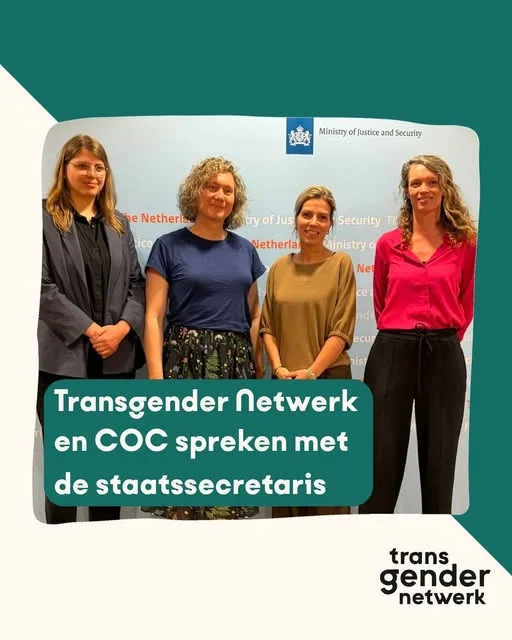
THE HAGUE – Representatives from Dutch LGBTQ+ advocacy groups, including COC Nederland, recently met with State Secretary for Justice and Security, Marieke van Bruggen, to address the persistent legal and administrative barriers facing transgender and non-binary people in the Netherlands.
The discussion focused on the daily, practical consequences of a legal system that has not kept pace with the reality of gender identity, particularly for non-binary individuals and transgender youth.
The Daily Reality of Mismatched Documents
Advocates shared how the inability for many to easily update their legal name and gender marker leads to frequent, unnecessary, and often unsafe situations. These encounters, which can effectively 'out' a person against their will, occur in mundane circumstances that others take for granted:
- At school, where official records may not match a student's identity.
- At the post office, when an ID is required to pick up a package.
- At customs and border control, leading to stressful and invasive questioning.
These situations, the groups argued, are preventable administrative failures that place a significant burden on the safety and mental well-being of transgender people.
A Two-Tier System for Gender Recognition
A key point of contention raised with the State Secretary is the current legal framework, which creates an unequal system for gender recognition. While some transgender individuals can change their gender marker through a relatively straightforward administrative process, non-binary people seeking an 'X' in their passport are forced to petition a court.
This legal hurdle is not only a financial and emotional burden but also creates a significant barrier to legal recognition. Furthermore, even those who successfully obtain an 'X' marker report ongoing difficulties. Many companies and official bodies, from banks to insurance providers, have systems that are not equipped to handle a gender marker other than 'M' or 'F', leading to administrative dead-ends and exclusion.
Renewed Calls for the Transgender Act
Against this backdrop, the coalition of advocates strongly urged Van Bruggen to prioritize the reintroduction of the revised Transgender Act (Transgenderwet). The proposed legislation, which aimed to simplify the process of legal gender recognition by removing the requirement for an expert's statement, was controversially withdrawn from parliament last year due to a lack of political support. Its revival is seen by the community as a critical step toward self-determination and safety.
The organizations described the conversation with the State Secretary as constructive and are now awaiting concrete proposals from the ministry to tackle these pressing issues. The ultimate goal, they emphasized, is to create a society where all individuals can navigate daily life safely and with their identity fully and simply recognized.