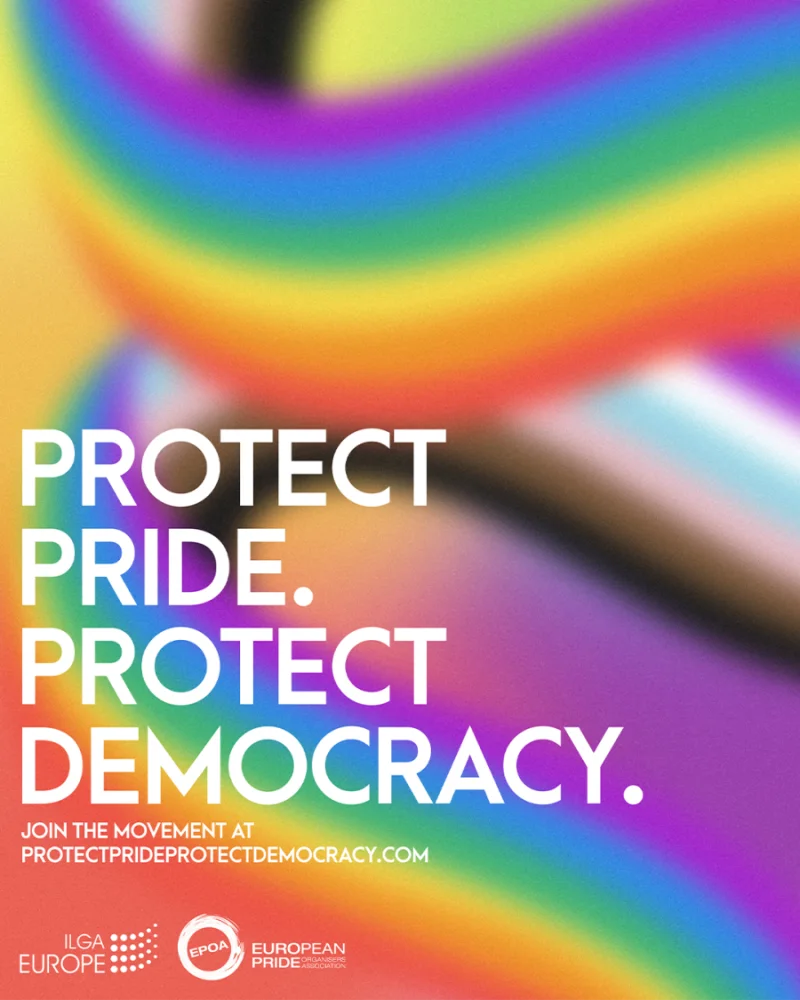
"When Pride thrives, democracy succeeds."
The European Pride Organisers Association (EPOA) has published the first edition of State of Pride in Europe, the most detailed survey yet of the people who actually put on Pride. Drawing on responses from 112 organisers — from Nuuk in Greenland to Tbilisi in Georgia and Yerevan in Armenia — the report paints a picture of a movement that is expanding and diversifying across the continent, even as a growing number of organisers report bans, hostility, and shrinking budgets.
The headline finding is one of resilience. Some 65% of organisers say their events have grown since 2022, and Pride has become far more than a single march: 94% now host cultural activities such as concerts, theatre and exhibitions, and 70% run educational programmes. Yet the same survey finds that 40% have seen their funding fall over the past three years, and that threats — online and off — are rising sharply.
Hungary: a ban defied, then undone
No story looms larger over the report than Hungary's. In March 2025, Viktor Orbán's governing Fidesz party pushed through legislation banning public assemblies that "violate" the country's child-protection law — the statute that forbids the "promotion or display" of homosexuality or gender transition to anyone under 18. In practice, it outlawed Pride. The prohibition was timed for the 2025 season, hitting Budapest Pride in June and, later, Pécs Pride in October.
The state did not stop at the law on paper. Participants faced fines ranging from roughly 6,500 to 200,000 forints (about €16 to €500), organisers risked up to a year in prison, and trucks mounted with biometric facial-recognition cameras were positioned along the route to identify those who showed up. The intent was clearly to deter.
It backfired spectacularly. The 30th edition of Budapest Pride became the largest in Hungarian history, with organisers estimating up to 200,000 people on the streets — many of them first-timers and allies who framed the day not only as a defence of LGBTQI+ rights but of Hungary's democratic future. Opposition figure Péter Magyar called the crackdown "not a goal, but a huge own goal." What was meant to suppress the march turned it into a mass demonstration.
The aftermath cut the other way. Criminal proceedings were opened against Budapest mayor Gergely Karácsony, questioned over his support for the march, and against Pécs Pride organiser Géza Buzás-Hábel. But after the April 2026 elections brought a change of government, the legal ground collapsed: on 21 April 2026 the Court of Justice of the European Union struck down the underlying anti-LGBTQI+ statute, and on 4 June 2026 prosecutors dropped the charges against both men, citing the ruling. Hungarian police have since cleared Budapest Pride to proceed in 2026, finding "no grounds for prohibiting the assembly" — though, as the report notes, the 2025 prohibition has not yet been formally repealed, and Orbán's surveillance apparatus remains in place.
Restricted elsewhere — often quietly
Hungary is not alone. Pride is also prohibited or severely restricted in Turkey, Georgia and Armenia. 2025 marked the tenth anniversary of the ban on Istanbul Pride, where activists who took to the streets were quickly dispersed by police, while in Georgia foreign funding for organisers was criminalised under a new Foreign Agents Registration Act. But the report stresses that outright bans are the exception. Far more common are "implicit" restrictions — informal advice from police or officials to cancel events, justified by safety, traffic or "public decency" concerns. Twenty-two organisers said they were required to cover policing or security costs themselves, a significant financial burden quietly shifted onto volunteers.
Hate speech is still on the rise
A striking 81% of organisers reported experiencing online hate speech against their teams, and 63% said it had increased over the past three years. Beyond the screen, 37 respondents reported vandalism or destruction of Pride property, and 24 reported death threats or threats of physical violence against team members. Even where governments are broadly supportive — 56% described their authorities as having "a friendly and helpful attitude" — nearly half (47%) still reported hostile messaging from politicians at the local, regional or national level.
Run by volunteers, stretched to the limit
Behind the festivals is a movement running largely on goodwill. More than half of organisers (53%) operate with no paid staff at all, relying entirely on volunteers. The toll shows: burnout is described as a "frequent" problem by 34% and an "occasional" one by a further 45%. Funding is modest across the board, with the most common budget band sitting between €10,000 and €50,000, and no clear sign that any one region is better resourced than another. Only eight Pride events across the whole of Europe report budgets of €1 million or more — concentrated in the capitals and largest cities of Spain, Austria, Switzerland, the Netherlands and the Nordic countries.
A movement beyond the capitals
The report also challenges the idea of Pride as a big-city phenomenon. The average organisation is around 20 years old — the oldest being Barcelona, founded in 1977 — and the great majority are registered NGOs. Some 68% are based outside national capitals, with Pride increasingly taking root in small towns and villages, from Ojén in Spain to communities choosing to swap a one-day march for a multi-day festival in order to ease the strain on volunteers and build lasting local presence.
What comes next
The findings land in a milestone year for the movement. EuroPride 2026 is being hosted in Amsterdam — doubling as WorldPride — where organisers are campaigning to have Pride recognised as intangible cultural heritage, including a bid for the UNESCO list. EuroPride then moves to Turin in 2027 and the West of Ireland in 2028. EPOA frames its report as a tool for organisers, funders and policymakers alike, arguing that the health of Pride is a barometer of civic space itself. As president Patrick Orth puts it: when Pride organisations struggle, "this often signals wider challenges affecting human rights and democratic participation."
The full State of Pride in Europe report is available from the European Pride Organisers Association at epoa.eu.