
22
Aug
A double bill featuring a lyrical reconstruction of poet Langston Hughes' life and the Harlem Renaissance, and an intimate documentary about three trans men working at a Tokyo nightclub.
Looking for Langston & Shinjuku Boys
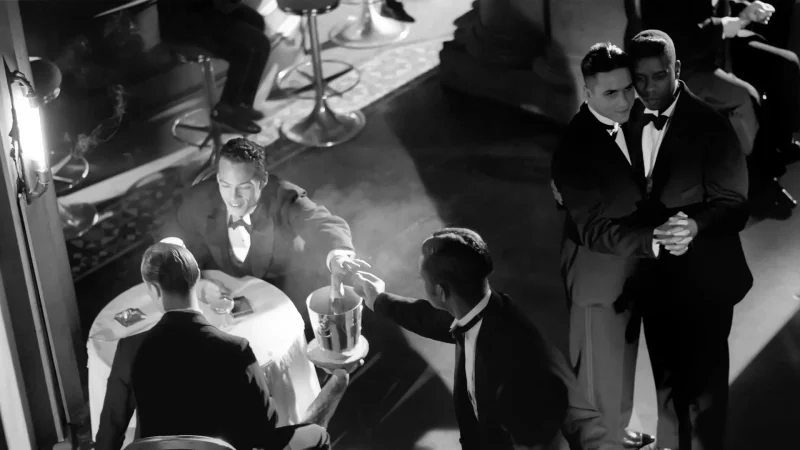
Queer Power: Looking for Langston & Shinjuku Boys
This screening is part of the Queer Power series. World Pride is coming to Amsterdam! Celebrate freedom, diversity, and inclusion at Eye, where Queer Power puts queer films from a wide range of countries and cultures in the spotlight all summer long.
This programme features two films:
Looking for Langston (Isaac Julien, GB 1989, 45')
An early work by filmmaker and visual artist Isaac Julien. The film is an ode to the American poet and writer Langston Hughes (1901-1967). Hughes was a prominent member of the Harlem Renaissance, an intellectual and artistic movement that emerged in the 1920s around Afro-American artists and writers.
Isaac Julien examines Hughes’ identity as a Black and gay cultural icon. The film evokes the atmosphere of a Harlem speakeasy, combined with the feel of a 1980s London nightclub. The texts are taken from works by Hughes and other prominent Black writers. The result is a landmark film that celebrates Black culture and homosexuality. Winner of a Teddy Award for Best Short Film at the Berlin International Film Festival.
Isaac Julien began making films in the 1980s and co-founded the Sankofa Film and Video Collective. Dissatisfied with the limitations of the film industry, over the years he has increasingly focused on making experimental film installations. Interdisciplinary collaborations are an integral aspect of his practice, and his films blend poetry, architecture, dance, painting, music, fiction and reality. Julien’s award-winning work is extensively exhibited and collected around the world.
Shinjuku Boys (Kim Longinotto & Jano Williams, GB 1995, 53')
Kazuki, Tatsu and Gaish are referred to as ‘onabe’ – the Japanese expression for people born with female gender characteristics who present as men, either with or without undergoing surgery and hormone therapy.
These three hosts who work in the Marilyn Club in the bustling Shinjuku entertainment district are trans men, who every evening do their utmost to entertain the exclusively female visitors to the Club. Directors Kim Longinotto and Jano Williams follow them both at work and at home. The protagonists talk openly about their lives and reveal their vision of love, sexual orientation, traditional relationships and identity.
The interviews are interspersed with colourful footage shot in the club – a place frequented mainly by heterosexual, cis women.
For Shinjuku Boys, directors Kim Longinotto (Dreamcatcher, Salma) and Jano Williams partly made use of the fly-on-the-wall method (also known as ‘direct cinema’), which involves filming as observation, without any intervention – no script, no narrative lines set out in advance, no sophisticated technology. With the aim of getting people in front of the camera in the most natural, convincing way possible.
Eye Filmmuseum
IJpromenade 1, Amsterdam, Netherlands
Queer Places Nearby
Upcoming
IJpromenade 1, Amsterdam, Netherlands
Queer Places Nearby
Super Lyan
Bar in Amsterdam
Bar in Amsterdam
Sauna Nieuwezijds
Cruising in Amsterdam
Cruising in Amsterdam
Ashoka
Restaurant in Amsterdam
Restaurant in Amsterdam
Upcoming