
20
Apr
Six performers embrace melancholy. Not as an illness or a romantic image, but as a powerful desire.
Tue, 20 Apr 2027
20:00
de Brakke Grond, Amsterdam
Wed, 21 Apr 2027
20:00
de Brakke Grond, Amsterdam
Ferenc Balcaen / NTGent: Please, Open The Curtains
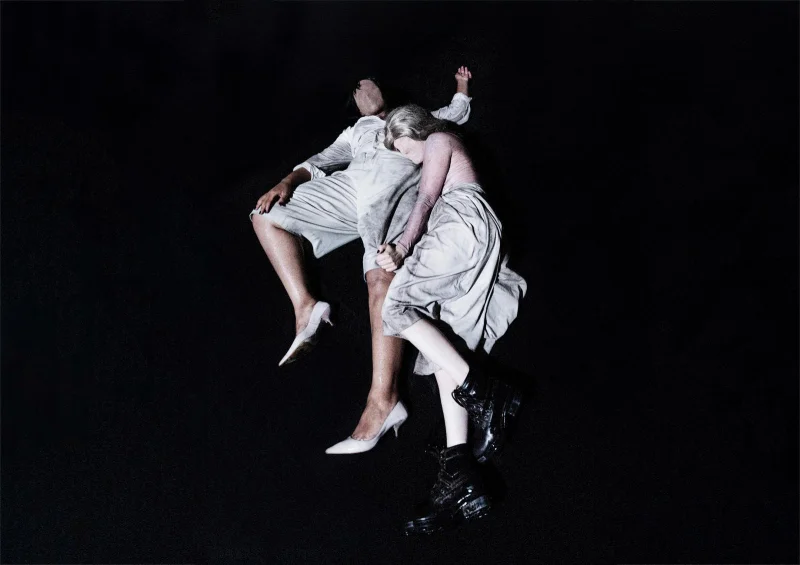
In season 26-27, NTGent will host a new project by promising Flemish theatre maker Ferenc Balcaen (1997). Balcaen previously impressed audiences with his graduation performance Tristis (2022), a visceral exploration of human metamorphoses inspired by Hieronymus Bosch's painting The Garden of Earthly Delights, and with Scapegoat (2024), in which he uses a broad palette of musical genres and traditions to encounter the inhabitants of Dante's Inferno.
PLEASE, open the curtains, produced by NTGent in coproduction with DESINGEL and Hermes Ensemble, is a theatrical exploration of melancholy. It reflects on social alienation, vulnerability, human connection, and the emotional weight of change and loss. Forgotten figures lose themselves in solitude, wandering through a space that forces them to face their emptiness. The floor, cold as steel, gently trembles beneath their feet. Artificial flowers appear to bloom, but only serve as echoes of something that was once vibrant.
In this performance, inspired by Delia Derbyshire's The Dreams and Bruegel's Landscape with the Fall of Icarus, melancholy is not presented as a weakness, but as a search for connection and solace. It is a confrontation with instability and transience. A plea for beauty and hope.
Six performers embrace melancholy through collective scenes where play, labor, and ritual coexist. Sometimes light and playful, sometimes slow and serene. Their bodies form an ensemble in which images and small gestures circulate. The scenography is a living body, a symbolic landscape that evokes, distorts, and reconstructs the past.
About Melancholy
Melancholy has never been neutral. Hannah Arendt described it as the 'calm in the eye of the storm': a silence that is simultaneously part of movement. In melancholy, one feels the gap between the world as it is and the world as it should be. This gap cannot be closed, and for this very reason, melancholy can bring both despair and hope. Throughout history, however, this feeling has been unevenly distributed.
For men, melancholy often had an elevated status: a sign of genius, reflection, artistry. For women and queers, a similar experience was consistently reduced to pathology. Their sadness became 'hysteria', their loneliness 'neurosis'. In his essay Mourning and Melancholia (1917), Freud spoke of the hidden mourning for a lost or forbidden love. Judith Butler has pointed out that this mechanism drives queer people into a state of permanent melancholy: their grief is made socially invisible and thus turns inward. Julia Kristeva understood melancholy as a collapse of language, a loss that can only be expressed through silence or art.
It is tempting to interpret this history solely as one of oppression, but there is also another movement underway. Women and queer artists have gradually reclaimed melancholy. Where their bodies were long depicted as hysterical, they made melancholy visible again as a source of creativity and resistance. In the work of Frida Kahlo, suffering takes the form of a self-portrait; in that of Nan Goldin, a collective memory of loss; in that of Tracey Emin, installations that transform shame into testimony. In this way, melancholy proves to be more than an individual state. It is a political sensibility, a way of looking that acknowledges both loss and desire.
Enclosed Garden
For the scenography, PLEASE, open the curtains draws inspiration from the enclosed garden (hortus conclusus), a medieval religious motif that dates back to the biblical Song of Songs, where it symbolizes the virginity and sanctity of Mary. In monasteries, the enclosed garden served as a place for silence, prayer, and healing, often filled with symbolic plants. In the 15th and 16th centuries, small-scale artworks (altarpiece-like assemblages) depicting this motif also emerged in the Southern Netherlands.
The enclosed garden referred to Mary's purity, but also to paradise, the cosmos in miniature, and the harmony of creation. In artworks, Mary is often depicted in a walled garden, surrounded by symbolic flowers. The motif also lives on in contemporary art, albeit in more abstract forms: walled spaces or figures that evoke silence, seclusion, and mystery. These modern variations invite introspection and multiple layers of interpretation.
Credits
- With: Ellen Sterckx, Pepijn Vandelanotte, Meron Verbelen, Marie-Christine Verheyen, Ferre Vuye, An Pierlé
- Direction: Ferenc Balcaen
- Dramaturgy: Marie Peeters
- Lighting Design: Dennis Diels
- Set Design: Lars Uten
- Backdrop: Lukas De Ryck
- Costumes: Lynn Van Hoydonck
- Music: Jolan Decaestecker, Mees Vervuurt
- Outside Eye: Mesut Arslan
- Dance Coaching: Georgina Teunissen
- Production: NTGent
- Co-production: STUKLeuven, DE SINGEL, Muziektheater Transparant
- With thanks to: HERMESensemble, Platform 0090
de Brakke Grond
Nes 45, Amsterdam, Netherlands
Queer Places Nearby
Upcoming
Nes 45, Amsterdam, Netherlands
Queer Places Nearby
Cafe the Minds
Bar in Amsterdam
Bar in Amsterdam
Cafe Belgique
Bar in Amsterdam
Bar in Amsterdam
Café Katoen
Bar in Amsterdam
Bar in Amsterdam
Upcoming
LGBTQIA+ Book Club Amsterdam October: The Safekeep by Yael van der Wouden
Wednesday, 14-10-2026, 20:00, Amsterdam
Wednesday, 14-10-2026, 20:00, Amsterdam