A new study on the attitudes of young people in the Netherlands has painted a complex and sometimes contradictory picture of LGBTQ+ acceptance. The research, conducted by the University of Amsterdam and commissioned by the Ministry of Education, Culture and Science, found that while a solid majority of Dutch youth support rights related to sexual orientation, they show significant resistance when it comes to gender identity and expression.
The report, titled "De lhbtiq+-opvattingen van jongeren," surveyed nearly 32,000 students aged 12-18 across 122 secondary schools between 2021 and 2024. Its findings challenge the narrative that LGBTQ+ equality is a settled issue for the next generation, revealing a clear fault line between the 'LGB' and the 'T' in the community's acronym.
Key Findings: A Tale of Two Acronyms
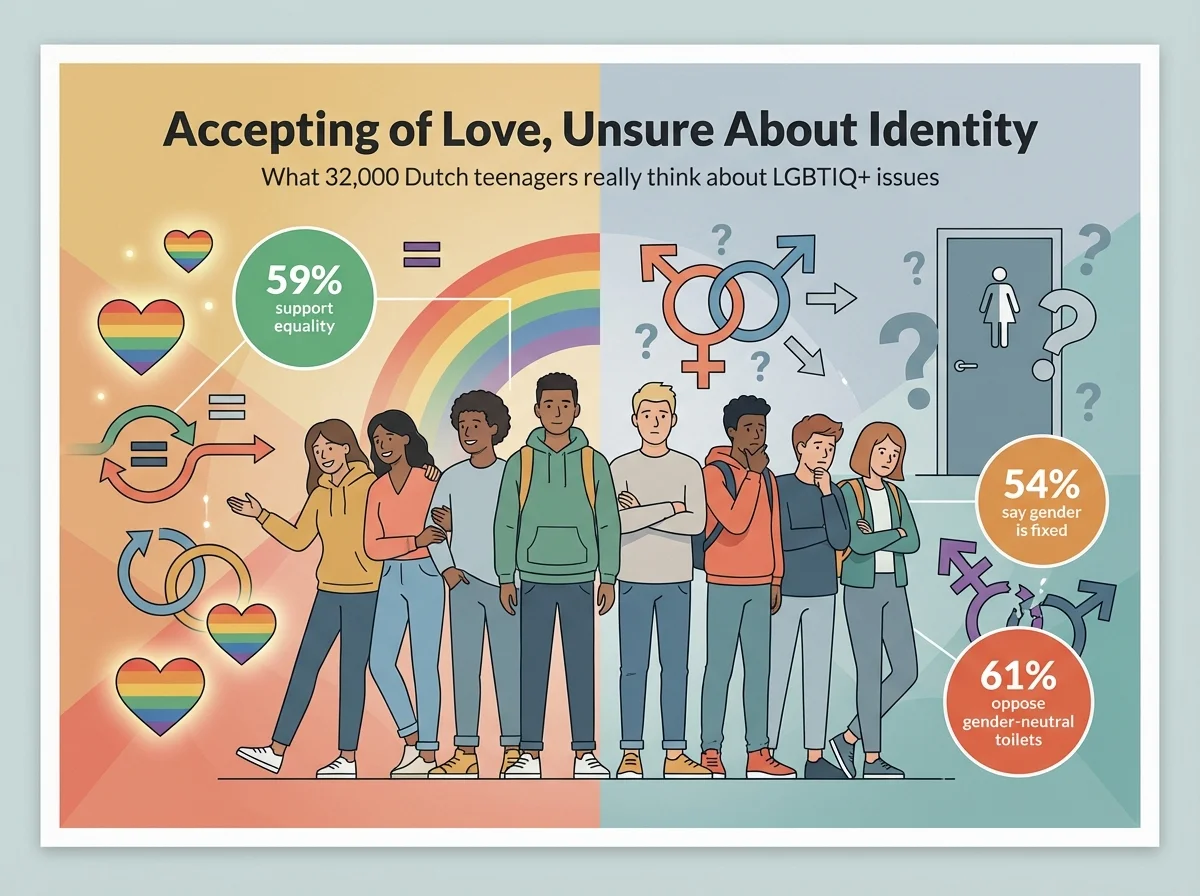
The data shows a distinct split in attitudes. On one hand, acceptance of sexual diversity is relatively high:
- 65% of young people agree that you should be free to choose whom you love.
- 59% agree that everyone is equal, regardless of whom they love.
However, on questions concerning transgender and non-binary identities, the sentiment shifts dramatically:
- 54% believe that gender is fixed from birth and cannot be changed.
- 61% are opposed to having gender-neutral toilets in their schools.
- Support for Purple Friday, a national day for LGBTQ+ awareness in schools, is almost evenly split, with a large group (28%) remaining neutral.
We at qMeetNL note this aligns with the history of LGBTQ+ rights in the Netherlands, where acceptance of same-sex relationships has had decades to become mainstream, while transgender and non-binary visibility is a much more recent and politically charged topic.
Beyond the Headlines: Slim Majorities and a Silent Middle
While the report frames its findings in terms of majorities, a closer look reveals that on many issues, opinions are far from unanimous. For instance, the 54% who believe gender is fixed are countered by 36% who disagree, with 12% undecided. This indicates that for many young people, these are not deeply entrenched beliefs but rather evolving opinions.
The large number of neutral responses on several questions, particularly regarding Purple Friday, suggests a significant portion of students are either disengaged or hesitant to take a firm stance. This sizable middle ground could be crucial in future conversations about inclusion.
An Unexpected Shift in Girls' Attitudes
Contrary to the common assumption that boys drive conservative trends, the study found a notable shift among girls. Between 2021 and 2024, boys' attitudes remained largely stable. In contrast, the proportion of girls holding conservative views on LGBTQ+ topics increased. For example, the share of girls categorized as conservative on the statement "all people are equal, including same-sex couples" rose from 23% to 37% in just three years.
While the researchers caution that the statistical effect is small, the direction of the trend is consistent and narrows the previously reliable gap where girls were significantly more progressive than boys.
Religion a Stronger Predictor Than Background or Education
The study also challenged other long-held assumptions. It found no significant difference in attitudes between youth with and without a migration background. The level of education (from pre-vocational vmbo to pre-university vwo) also proved to be a weak predictor of a student's views.
The one factor that did show a strong correlation was religion. Young people identifying as Muslim held the most conservative views, followed by those identifying as Christian. Non-religious youth were, on average, the most progressive, though a substantial minority within this group also held conservative views on gender identity.
An Unfinished Agenda
The overarching conclusion from the University of Amsterdam researcher is clear: LGBTQ+ acceptance among Dutch youth should not be taken for granted. The findings suggest that while decades of advocacy have secured broad support for lesbian, gay, and bisexual people, the conversation around transgender and non-binary identities is at a much earlier, more contentious stage. For advocates, educators, and the community, the report serves as a vital, data-driven roadmap indicating where the most urgent work remains to be done.