The musical tells the story of Franklin Shepard, a talented composer who abandons his friends and his art for a life of commercial success in Hollywood. Uniquely, the narrative unfolds in reverse, beginning at the bitter end of his friendships in 1976 and traveling backward in time to the group's optimistic first meeting in 1957.
While the musical's text does not contain explicitly queer characters or plotlines, it has long been interpreted through a queer lens, owing to its creators and its resonant themes of fractured friendships, compromise, and regret. This recent revival, in particular, has brought those undercurrents closer to the surface.
A Story Shaped by Queer Creators
Merrily We Roll Along was written by two gay men: composer and lyricist Stephen Sondheim and book writer George Furth. Their personal experiences in the mid-20th century entertainment industry inevitably inform the show's exploration of what it costs to conform and the private pain that can hide behind a public persona. The pressure to present a certain version of oneself to the world is a central tension in the musical, a theme with deep roots in queer history.
Reading the Central Trio
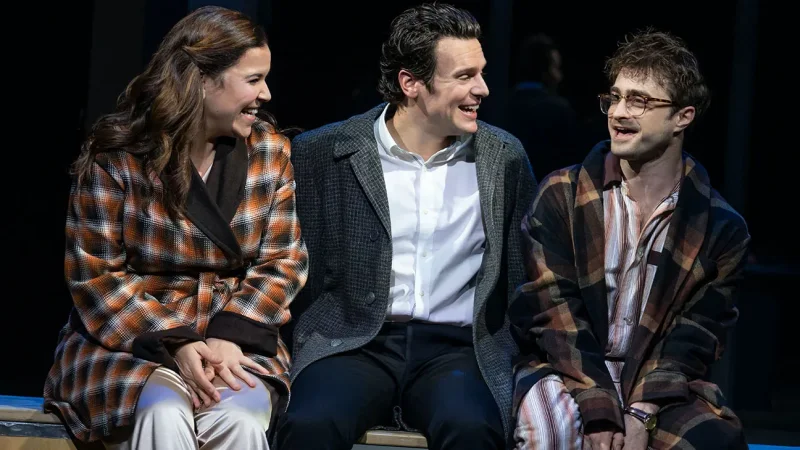
The complex, often painful dynamic between the three main characters—Franklin, Charley, and Mary—is where many queer interpretations are focused.
- Franklin Shepard (Jonathan Groff): As the protagonist who loses his way, Frank's journey is one of constant compromise. Groff, an openly gay actor, has spoken about connecting Frank's internal pressure to "say yes when I meant no" with the experience of being closeted. His performance brings a specific vulnerability to a character whose motivations can otherwise seem purely selfish.
- Charley Kringas (Daniel Radcliffe): Charley, Frank's lyricist and best friend, is often read as being in unrequited love with him. This interpretation transforms his famous breakdown song, "Franklin Shepard, Inc.," from a professional rant into a deeply personal and painful public breakup. It becomes the lament of a man watching the person he loves destroy himself and their shared world.
- Mary Flynn (Lindsay Mendez): Mary's long-standing, unrequited love for Frank positions her as the perpetual outsider looking in. This perspective of observing a world to which one can never fully belong is a familiar narrative for many in the LGBTQ+ community. The character was also partly inspired by Sondheim's close friend Mary Rodgers, who harbored her own unrequited feelings for him.
The Revival's Resonance
This production doesn't change a word of the original text, yet the casting and performances allow the subtext to feel more present. The story of Gussie Carnegie, a minor character who changes her name, her appearance, and her past to achieve success, can also be seen as a parallel to the queer experience of assimilation into a heteronormative society.
For audiences in the Netherlands, the Netflix release offers a chance to see a landmark production that explores the universal, and often queer-coded, complexities of friendship, ambition, and the high price of selling out.
The proshot of Merrily We Roll Along was released on Netflix on April 4, 2026, and is available for streaming in the Netherlands.