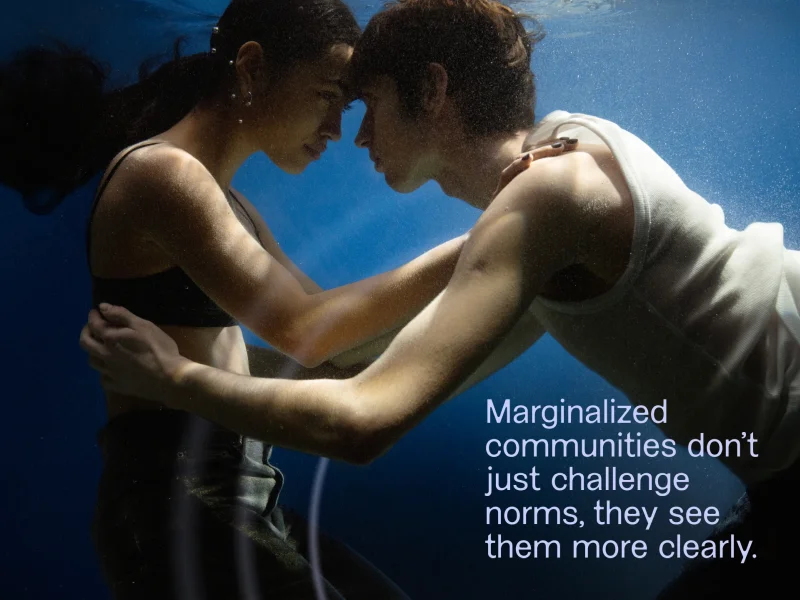
The report, titled "State of Reflections," surveyed over 5,700 people, comparing the attitudes of its own user base with those of the general public. The findings reveal a significant gap in how different groups perceive everything from sexual orientation to non-monogamy and kink, challenging the very idea of a single, dominant social norm.
A Widening Gap in Acceptance of Sexuality
One of the most telling findings relates to perceptions of non-heterosexual identities. According to the data, 36% of men surveyed from the general population view non-straight sexuality as "abnormal." In stark contrast, only 13% of Feeld respondents who identify as women held the same view.
The report, co-authored by Dr. Apryl Williams of the University of Michigan, posits that those who have experienced stigma themselves are more adept at recognizing and resisting it in other contexts. This may resonate with many in the LGBTQ+ community, where navigating societal bias is a common experience. The data suggests this lived experience fosters a greater capacity for empathy and acceptance of diverse identities.
Feeld's data also indicates that exposure to diverse communities can increase acceptance over time. Members who had been on the app for one to three years rated non-straight sexualities as 6% more "normal" than new members, suggesting that community immersion plays a role in deconstructing preconceived notions.
Non-Monogamy: Niche or Just Misunderstood?
The study also delves into attitudes toward non-traditional relationship structures like ethical non-monogamy (ENM) and polyamory—dynamics often explored within queer communities.
The difference in perception was substantial:
- 72% of Feeld members consider alternative relationship structures to be "somewhat" or "extremely normal."
- Only 27% of the general survey respondents said the same.
- Conversely, 28% of the general group believe these structures are abnormal, compared to just 8% of Feeld members.
This highlights a key theme of the report: communities that embrace non-normative identities do not stigmatize traditional ones (like monogamy), whereas the mainstream is more likely to stigmatize the unconventional.
Kink, Consent, and the Power of Conversation
While kink is often portrayed as a fringe activity, the report found that it's more common than many believe, with 42% of general respondents reporting they engage in it. Interestingly, some practices like role-play were slightly more common in the general sample than among Feeld users (44% vs 41%).
However, the crucial difference lies not in the practice of kink, but in the communication surrounding it. The report identifies a massive disparity in the normalization of conversations about safety and consent:
- 70% of Feeld members rated prioritizing conversations about consent as normal, compared to only 23% of the general public.
- Similarly, 75% of Feeld members saw talking about safe sex as normal, versus just 25% of the external group.
This data suggests that communities where kink and non-normative desires are openly discussed have also normalized the essential conversations required for safety and mutual respect. By moving these topics out of the shadows, they become destigmatized, creating a healthier environment for exploration.
Conclusion: You Are the Norm
Ultimately, the report concludes that "normal" is not a fixed point, but a subjective standard defined by one's own community and experiences. What is popular or visible in mainstream media is not necessarily what is most common or even what a majority of people truly desire.
For the LGBTQ+ community, these findings may serve as a data-backed affirmation: that by living outside of traditional norms, individuals are not "abnormal," but are part of a diverse and expanding landscape of human connection that often pioneers healthier and more honest ways of relating.