
23
Aug
A screening of Jean Genet's scandalous silent film 'Un chant d'amour' about homoerotic fantasies between prisoners, followed by Erwin Olaf & Frans Franciscus’ 'Tadzio'.
Un chant d'amour & Tadzio
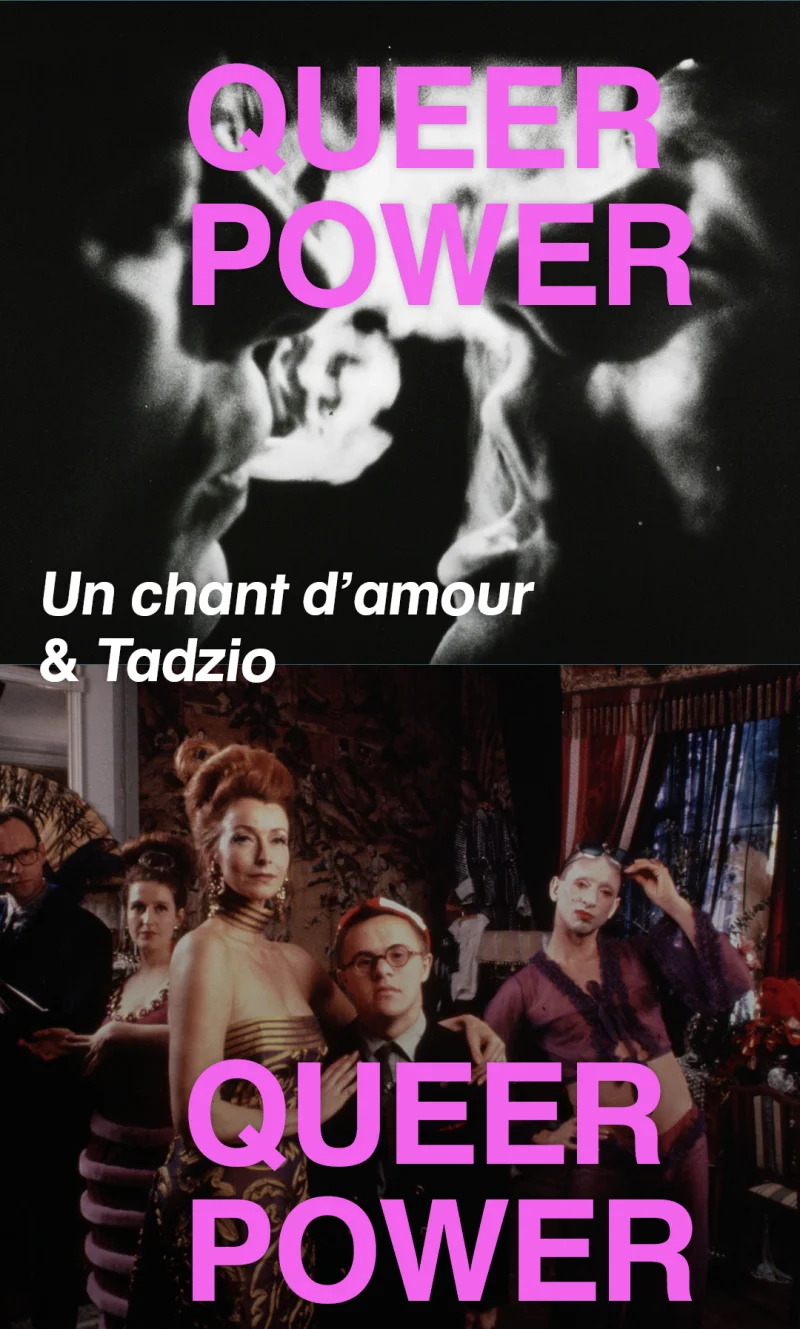
Queer Power: Un chant d'amour & Tadzio
With the silent film Un chant d'amour, in which two prisoners lose themselves in homoerotic fantasies, cult writer, thief and 'godfather of queer cinema' Jean Genet unleashed a national scandal. Followed by Erwin Olaf & Frans Franciscus’ hotly debated Tadzio.
This screening is part of the Queer Power and Eye on Art series.
Programme
Un chant d'amour (Jean Genet, 1950, 26')
Un chant d'amour, a silent film in which two prisoners lose themselves in homoerotic fantasies, brought down national outrage on cult author, thief and the ‘godfather of queer cinema’ Jean Genet, who incidentally wrote many of his books in prison.
Un chant d’amour (1951) is the only film made by writer Jean Genet. For decades, the film led an obscure existence, having been banned for its explicit depiction of homosexuality. Alongside the guard, Genet observes the prisoners in their cells. The film evokes many odours: a woollen sweater, the straw on the beds and the smoke one inmate shares with his neighbour by means of a straw stuck through the wall. In short: power and desire, brilliantly depicted in the form of a romantic love song.
The film is being screened as Genet intended: without dialogue and without sound.
Tadzio (Erwin Olaf & Frans Franciscus, 1991, 32')
On the set of a feature film, the lead is preparing for her scenes. In the meantime, her son wanders around the house. The role is played by Aat Nederlof, an actor born with Down’s syndrome. He plays Tadzio, a young Polish adolescent who ignites intense passions in older man Gustav von Aschenbach in Visconti’s film Death in Venice.
Well-known artists including Tosca Niterink, Arjen Ederveen, Hans van Manen and Theo van Gogh (in a tennis outfit à la Betty Stöve) also appear. The set is by Ben van Os, the well-known set designer who often worked with Peter Greenaway. Marie Kooyman plays the role of Tadzio’s film diva mother.
Reinier van Brummelen, later regular cameraman for Peter Greenaway and Ben Sombogaart, shot the marvellous 16mm footage in an underground style on the Oud Amelisweerd country estate as part of the 'Film x Visual Art' programme which invited artists to respond to the building.
Eye Filmmuseum
IJpromenade 1, Amsterdam, Netherlands
Queer Places Nearby
Upcoming
IJpromenade 1, Amsterdam, Netherlands
Queer Places Nearby
Super Lyan
Bar in Amsterdam
Bar in Amsterdam
Sauna Nieuwezijds
Cruising in Amsterdam
Cruising in Amsterdam
Ashoka
Restaurant in Amsterdam
Restaurant in Amsterdam
Upcoming